Monday, July 7, 2014

Jetstar Japan carries 5 millionth passenger.

On July 6th, Jetstar Japan (GK/JJP) announced that they have carried a total of 5 million passengers since beginning operations on July 3rd, 2012. The Tokyo/Narita (NRT/RJAA)-based carrier became the second of Japan's so-called 'Year-Zero LCCs' to reach the milestone after Peach Aviation (MM/APJ) (Peach reaches 5 million passengers.), but faster, achieving it in 733 days.
Airbus A320-232 JA03JJ lands at rainy Chubu Centrair Airport near Nagoya. (Photo: Jetstar Japan)

When the Japanese unit of Australia's successful LCC launched services two years ago, it started out with only two routes; Narita to Fukuoka (FUK/RJFF) and Sapporo/New Chitose (CTS/RJCC). Now it has grown to 14 domestic routes covering 10 destinations with a fleet of 18 Airbus A320s, recording an all-time in-service rate of 98.5% and an on-time arrival rate of 85.8%. Their long-awaited second hub at Osaka/Kansai (KIX/RJBB) was finally launched on June 12th (Jetstar Japan launches Kansai hub.) and regional international routes are expected from the Winter 2014/2015 timetable.

The 1 million mark was passed on March 22nd, 2013 (262 days), 2 million on August 12th (405 days), 2013, 3 million on December 6th, 2013 (521 days), and 4 million on March 24th, 2014 (629 days). Jetstar Japan is owned 33.3% by Qantas Airways (QF/QFA), 33.3% by Japan Airlines (JL/JAL), 16.7% by Mitsubishi, and 16.7% by Century Tokyo Leasing.

Reference: Aviation Wire, July 7th. (in Japanese)

Friday, July 4, 2014

Skymark to introduce ONE PIECE JET on July 19th.

On July 19th, Skymark Airlines (BC/SKY) will introduce ONE PIECE JET, a special livery based on Eiichiro Oda's popular Japanese Anime (cartoon) series. A total of five Boeing 737-800s will receive the special decals in the aft part of the fuselage and fly until October 19th. This is the first time Japan's third largest domestic carrier has opted for a cartoon-themed special scheme. Japan Airlines (JL/JAL) continues a partnership with Tokyo Disney Resort, while All Nippon Airways (NH/ANA) has an agreement with Pokémon, and in the past has had Snoopy (Peanuts)-themed airliners as well.
Flight attendants with Luffy's straw hat poses with a ONE PIECE JET model. (Photo: Aviation Wire)

Aircraft without the big decals will receive small stickers on the L1 door for the 737 and L1 and L2 doors for the Airbus A330 (Skymark Airlines inaugurates Airbus A330 service.), which just entered service on June 14th. The airline will have a stamp collection campaign for children over three years old and elementary (primary) school students, where one can get a stamp per flight, and a certain number of stamps will award the young passenger a Skymark-exclusive ONE PIECE merchandise. Some flight attendants will wear a straw hat, an icon of main character Monkey D. Luffy.

A closer look at the decals. Port side above, starboard side below. (Image: Skymark)

Along with the special livery, Skymark has introduced new discount child fares for the summer vacation season, available through August 7th, to lure family travelers. Price is set at 7,000 JPY one-way system-wide, except for Okinawa/Naha (OKA/ROAH) – Ishigaki (ISG/ROIG) and Naha – Miyako (MMY/ROMY), where the prices are 5,100 JPY. Flights can be changed for free if the same fare on the same segment is available. Refund fee is set at 500 JPY.

Reference: Aviation Wire, May 30th. (in Japanese)
Reference: Skymark Airlines, June 30th. (PDF; in Japanese) 
Reference: Aviation Wire, June 30th. (in Japanese)

Thursday, July 3, 2014

ANA returns to Aomori with Osaka and Sapporo flights.

On July 1st, All Nippon Airways (NH/ANA) resumed scheduled service at Aomori (AOJ/RJSA) with three daily round-trips to and from Osaka/Itami (ITM/RJOO) and two to and from Sapporo/New Chitose (CTS/RJCC). Operated by subsidiary ANA Wings' (EH/AKX) 74-seat Bombardier DHC-8-400Qs, the flights mark the return of now Japan's largest airline by passenger volume to Honshu's northernmost airport after a 11-year hiatus.
Bombardier DHC-8-402Q JA845A arriving at Aomori from Sapporo's New Chitose as NH1853 on July 1st, the inaugural day. (Photo: Ryosuke Yano)

The inaugural flight out of Aomori, NH1852, service to Itami, was operated by DHC-8-402Q JA856A with a load of 73 passengers. The aircraft had been ferried in to Aomori the night before. Sistership JA853A became the first to arrive, as NH1851 from Itami, and was greeted by a water-cannon salute.

Flight schedule (July 1st - October 25th):
Osaka/Itami – Aomori NEW 3 daily with DHC-8-400Q. *Operated by ANA Wings.
NH1851 ITM 0815 – 1000 AOJ DH4 Daily
NH1853 ITM 1155 – 1340 AOJ DH4 Daily
NH1855 ITM 1910 – 2055 AOJ DH4 Daily
NH1852 AOJ 0805 – 1000 ITM DH4 Daily
NH1854 AOJ 1310 – 1505 ITM DH4 Daily
NH1856 AOJ 1740 – 1935 ITM DH4 Daily

Aomori – Sapporo/New Chitose NEW 2 daily with DHC-8-400Q. *Operated by ANA Wings.
NH1897 AOJ 1030 – 1120 CTS DH4 Daily
NH1899 AOJ 1510 – 1600 CTS DH4 Daily
NH1898 CTS 1150 – 1240 AOJ DH4 Daily
NH1900 CTS 1615 – 1705 AOJ DH4 Daily
 
A ceremony took place at Aomori Airport, attended by Aomori Prefecture Governor Shingo Mimura, Aomori City Governor Hiroshi Shikanai, and ANA's Executive Vice President for Sales and Marketing Takashi Shiki. ANA President Osamu Shinobe visited Mr. Mimura one day before. "We've been waiting for this moment. We would like to strengthen our partnerships with the Kansai (Greater Osaka) region to promote tourism and help the route grow," said Mr. Mimura, adding "Ahead of that lies another big ambition," hoping for ANA's resumption of their Tokyo/Haneda (HND/RJTT) link. Mr. Shiki responded, "We have a big international network from Haneda now (ANA's Summer 2014 international expansion.). We also share the desire to open up Aomori's charm to the world."
The brand-new ANA counters at Aomori with celebration flower decorations. (Photo: Ryosuke Yano)
 
Aomori has seen turbulent times in recent years. In FY2003, its annual passenger number recorded 1.41 million, however, after the merger of Japan Airlines (JL/JAL) and Japan Air System (JD/JAS) was complete, ANA withdrew from Aomori in April that year, axing its link to Haneda and shifting the precious slots to more lucrative routes. Skymark Airlines (BC/SKY) briefly filled the vacancy but withdrew in November. JAL's financial woes forced the airline to cut its link to Fukuoka (FUK/RJFF) in 2007 and Nagoya/Chubu Centrair (NGO/RJGG) in 2010. Dealing a further blow, the opening of the super-efficient Shinkansen (bullet train) to Aomori in 2010 followed shortly by the 3.11 Great East Japan Earthquake reduced the number to merely 800,000 for FY2010.

The Nagoya link was restarted by Fuji Dream Airlines (JH/FDA) with service (CoachFlyer JH366: AOJ – NKM on Fuji Dream Airlines' Embraer E175.) to its older airport at Komaki (NKM/RJNA) in 2011. Other than the ANA and FDA flights, Aomori is served by Japan Airlines (JL/JAL) with three-times daily each to New Chitose and Itami (operated by J-Air), and six-times daily to Haneda, while Korean Air (KE/KAL) maintains a three-times weekly service to Seoul/Incheon (ICN/RKSI) (CoachFlyer KE768: AOJ - ICN on Korean Air's Boeing 737.), the prefecture's sole scheduled international route. Passenger numbers slightly increased to 850,000 for FY2013.
Arriving passengers were greeted by ANA banners promoting the Aomori launch. To the right is a miniature version of Aomori's renowned Nebuta. (Photo: Ryosuke Yano)

For ANA, the resumption is also a strategy to experiment potential markets in Japan's mature domestic market (at least at ANA/JAL's costs) where the population has started to decline. ANA's most recent new domestic destination was Iwakuni (IWK/RJOI) in eastern Yamaguchi Prefecture, when the joint U.S. Air Force (USAF) - Japan Air Self-Defense Force (JASDF) base was opened up for civilian flights in December 2012.

Aomori hopes ANA's comeback will boost demand. In 2011, when ANA entered the Akita (AXT/RJSK) – Itami market in competition with JAL, passengers carried on the route increased from 100,000 in FY2011 to 170,000 in FY2013. On the other hand, airports such as Yamaguchi-Ube (UBJ/RJDC) saw passengers decline after JAL entered the ANA-dominated market in FY2002; the figure was 960,000 for FY2003 but had decreased to 850,000 in FY2013. Prefecture officials hope it doesn't "end up with both carriers losing money and terminating the route," and JAL's Aomori Office chief Yutaka Fukuda said "There's certainly potential demand. But two carriers serving the route doesn't mean the market will grow overnight. We need to make efforts."

Aomori is one of the most beautiful and diverse prefectures of Japan, but remains an under-served and under-explored tourist destination. From the Hakkoda Mountains, which gets heavier annual snowfall than anywhere else in Japan, to the renowned UNESCO World Heritage Site of Shirakami-Sanchi, picturesque Lake Towada to the nature abundant Shimokita Peninsula, Aomori is filled with fascinating vast landscapes. On the culture side, it is home to the famous Nebuta festival, when the entire prefecture goes for celebration in August, as well as the Sannai-Maruyama Ruins, one of the oldest archaeological sites in Japan dating back to 3900 B.C., and much more. Food is no exception, with the Tsugaru cuisine and the Nanbu cuisine, and forget not the fresh fish (Sashimi and Sushi) from the surrounding seas and the herbs from the mountains. There are countless Onsens (public hot spring baths) as well. 

Reference: Yomiuri Shimbun, June 29th. (in Japanese)
Reference: Yomiuri Shimbun, July 2nd. (in Japanese) 

*Post edited/updated on July 5th.

Wednesday, July 2, 2014

Vanilla Air launches Narita – Amami.

On July 1st, Vanilla Air (JW/VNL) launched Tokyo/Narita (NRT/RJAA) – Amami (ASJ/RJKA), becoming the first LCC to serve the leisure resort island situated in the Amami Archipelago between Kyushu and Okinawa. The first out-bound flight, JW821, operated by Airbus A320-216(WL) JA01VA touched down at Amami at 1309 JST, 14 minutes behind schedule, carrying 166 passengers. It was greeted by a water-cannon salute.
Airbus A320-216(SL) JA01VA prepares to depart Amami back to Narita. (Photo: Aviation Wire)

Flight schedule (July 1st - August 31st):
JW821 NRT 1030 – 1255 ASJ 32A/320 Daily
JW822 ASJ 1410 – 1630 NRT 32A/320 Daily
 
Flight schedule (September 1st - 30th):
JW821 NRT 1450 – 1715 ASJ 32A/320 Daily
JW822 ASJ 1755 – 2015 NRT 32A/320 Daily
 
Flight schedule (September 30th - October 25th):
JW821 NRT 0815 – 1055 ASJ 32A/320 Daily
JW822 ASJ 1130 – 1340 NRT 32A/320 Daily

The return flight, JW822, departed Amami at 1407, three minutes early, with a load of 55 passengers. Although the assigned aircraft could seat up to 180, Vanilla Air caps its flights at 166 due to their mixed fleet of 180-seat new and 166-seat secondhand (Vanilla Air's 'LOHACO Jet' enters service.) machines. All three of the latter, sourced from sister All Nippon Airways (NH/ANA), will be replaced by brand-new 180-seat A320s between September and November this year.

President Tomonori Ishii thanked the locals saying "I'm very happy. We decided on the launch only four months after we restarted (Vanilla Air launches operations.), but the Governor of Amami as well as the locals put a lot of effort and I've felt it. Reservations are coming along." He told reporters "Our target load factor is 80%. We believe there's a potential demand," citing the island's wide range of available outdoor leisure activities including sports camps, surfing, diving, snorkeling, and fishing. The fledgling LCC also targets the estimated 200,000 people of Amami-origin living in the Kanto (Greater Tokyo) region.

Speaking about the flight cancellations due to the shortage of pilots (Vanilla Air cancels 154 flights in June due to pilot shortage.), Mr. Ishii apologized "We are very sorry for that. We'll have a stable operation from July onwards. We're putting more resources to recruiting."

The Government of Japan and the Prefectural Government of Kagoshima together agreed to allocate 2.7 billion JPY under Amami Archipelago Promotion Fund effective April 1st, where financial support will be provided to businesses that help boost economy in the islands, and Vanilla Air's once-daily service also operates under this scheme. Located approximately 380 kilometers (240 miles) south of the southern tip of Kyushu and 250 kilometres (160 miles) north of Okinawa, Amami Oshima (which translates to Amami Big Island) is an island of volcanic origin with a humid subtropical climate. Its coasts are surrounded by coral reefs. 

Until this day, Amami had been served only by Japan Airlines' (JL/JAL) group; JAL Express (JC/JEX) operates one daily each from Osaka/Itami (ITM/RJOO) and Tokyo/Haneda (HND/RJTT) with Boeing 737-800s, while Japan Air Commuter (3X/JAC) links Fukuoka (FUK/RJFF), Kagoshima (KOJ/RJFK), Kikai (KKX/RJKI), Okinoerabu (OKE/RJKB), Tokunoshima (TKN/RJKN), and Yoron (RNJ/RORY) with Bombardier DHC-8-400Qs and Saab SF340s. Ryukyu Air Commuter (RAC) flies to Okinawa/Naha (OKA/ROAH). Amami has not escaped the radar of newcomers, however, as Skymark Airlines (BC/SKY) in 2010 and 2011 briefly operated seasonal service to and from Kagoshima, which has not resumed since. 

In the long run, Vanilla Air intends to direct 70% of its routes to overseas, meaning less emphasis on the domestic market. From its small base at Narita, the wholly-owned subsidiary of ANA Holdings currently flies to Okinawa/Naha (OKA/ROAH), Sapporo/New Chitose (CTS/RJCC), Seoul/Incheon (ICN/RKSI), and Taipei/Taoyuan (TPE/RCTP) with a fleet of six A320s. China, Guam, Hong Kong, Philippines, and Saipan are being considered, and Mr. Ishii quoted "Our next destination will probably be an Asian neighbor," though he said plans have not materialized yet.

Reference: Aviation Wire, July 1st. (in Japanese)

Tuesday, July 1, 2014

AirAsia Japan is officially reborn; first flight June 2015.

On July 1st, AirAsia Group CEO Tony Fernandes formally announced the launch of AirAsia Japan (Mk II) at a press conference in Tokyo. The newest unit of the Malaysia-based pan-Asian LCC group was officially formed on this day, with Mr. Fernandes saying "This is Part 2 of AirAsia Japan's performance, and it will be the last. We will bring Japan and the rest of Asia closer by offering affordable fares." First revenue flight is to take place in summer 2015.
Yoshinori Odagiri, AirAsia Japan (Mk II) CEO; Tony Fernandes, AirAsia Group CEO; and Hiroshi Mikitani, President of Rakuten (black shirt). (Photo: Aviation Wire)

An initial capital of 7 billion JPY has been raised from five investors; Malaysia's AirAsia (AK/AXM) accounts for 49%, Octave Japan Infrastructure Fund 19%, Rakuten 18%, Noevir Holdings 9%, and Alpen 5%. According to voting-rights, AirAsia will control 33%, the maximum possible figure allowed under Japan's current airline foreign ownership laws, while Octave will have 28.2%, Rakuten 18%, Noevir 13.4%, and Alpen 7.4%. "We are very excited to return to Japan's skies together with Octave, Rakuten, Noevir and Alpen this time round. I am more confident than ever that AirAsia Japan, led by Odi (Odagiri Yoshinori) with the strong partnership we have with our new investors, will continue to realize our vision to revolutionize the low-cost carrier segment of Japan," Mr. Fernandes said.

Octave was incorporated in Japan in May 2014 and its major business is to manage the shares of AirAsia Japan. Rakuten (AirAsia and Rakuten to announce AirAsia Japan on July 1st.) was an IT venture originally founded in February 1997 but now Japan's largest e-commerce firm, with other major businesses including financial services, telecommunications, and professional sports, owning the Tohoku Rakuten Golden Eagles baseball team. Noevir is involved in the cosmetics, pharmaceuticals, and health food and apparel industry. Alpen has been producing a wide range of sports equipment from ski, golf, tennis, marine sports, and baseball since 1972, and it also manages ski resorts, golf courses, and fitness clubs.
From top-left to right: Taizo Mizuno (President of Alpen), Hiroshi Mikitani (President of Rakuten), Yoshinori Odagiri (CEO of AirAsia Japan), Tony Fernandes (CEO of AirAsia Group), and Takashi Okura (President of Noevir Holdings). (Photo: Mynavi)

"If you look around the world, LCCs are stimulating air travel. Their share has grown to around 50% in Southeast Asia, but still only accounts for 3% in Japan. The country is now moving to increase foreign visitors to 20 million by 2020 (when the Tokyo Olympics/Paralympics take place). LCCs will play a pivotal role in surpassing that milestone and will also contribute to the country's economy," Mr. Mikitani said, adding "We are simply a shareholder supporting AirAsia's growth in Asia." Being a personal friend of Mr. Fernandes as well, he also said, "From in-flight entertainment to shopping and payments, the airline market has lots of possible synergies with IT. E-commerce partnerships are possible in the long-term."
 
CEO of AirAsia Japan (Mk II) is Yoshinori Odagiri (New AirAsia Japan names CEO; official launch in April.), who also headed the first incarnation. The failed 10-month joint-venture (JV) between AirAsia and All Nippon Airways (NH/ANA) has since relaunched as Vanilla Air (JW/VNL) (Vanilla Air launches operations.) under full ANA control. Starting out his aviation career with ANA back in 1987, Mr. Odagiri quit ANA and AirAsia Japan (Mk I) in August 2013, two months after the JV was dissolved (operations under the AirAsia brand continued through October 26th), and joined AirAsia the following month to help re-launch the red brand in the country of the rising sun. 

"AirAsia Japan has returned," Mr. Odagiri enthused, telling that operations will start as early as June 2015 on domestic routes, followed by regional international flights. An initial fleet of two 180-seat Airbus A320s will be sourced from AirAsia Group's huge order pool, with four planned by the end of 2015. Five will be added each year after that.
Some of AirAsia Japan's aircraft will feature special liveries designed by photographer and film director Mika Ninagawa. (Image: Mika Ninagawa)

Asked about their hub, Mr. Odagiri answered "Nagoya was chosen (New AirAsia Japan to be based at Nagoya Chubu Centrair.) for initial registration purposes. We will formally announce a hub in due course," adding "We will start from a non-Tokyo city, but Tokyo is a very big market that cannot be omitted. The (Japanese) government is considering increasing slots at Haneda, and we certainly would like to receive some." He went on to say "We first need to stabilize our business by producing profits on trunk (domestic) routes, and after that, we hope to enter the under-served rural (domestic) markets."

Regarding pilot shortages which have plagued LCCs Peach Aviation (MM/APJ) (Peach outlines Summer 2014 mass cancellations.) and Vanilla Air (Vanilla Air cancels 154 flights in June due to pilot shortage.) with mass cancellations, Mr. Odagiri said "We want to plan well, including crew sourcing from the group's other airlines."

Speaking about the Tokyo/Narita (NRT/RJAA)-based LCCs struggling to turn profits, Mr. Fernandes commented "Because they're based at high-cost Narita. And Haneda is not far away. If we take a different approach, we believe we can produce a profit in five or six years." He also said "What we learned the first time is that we should work with like-minded people. We make decisions very quickly. We'll do better than partnering with huge established corporations." For the failed first attempt, AirAsia erred in giving majority control to ANA, which made the move mostly to prevent AirAsia from partnering with other companies. As Mr. Mikitani's statement implies, AirAsia is at the controls this time, and the other investors are only supporters.
AirAsia's distinctive red flight attendants. Noevir will reportedly supply their cosmetics. (Photo: Mynavi)

"We are ready to take on this challenge and with great teamwork, we hope to bring AirAsia's successful low-cost business model once again to Japan. Our counterparts in Malaysia, Thailand, Indonesia, the Philippines, and India have seen great and encouraging responses in their markets, and we will work towards the same for Japan. We would like to thank the investors for their belief in us and we look forward to working closely with them moving forward," said Mr. Odagiri.

Now AirAsia Japan (Mk II) would be the fifth LCC in an already increasingly crowded market. Is market consolidation (any eliminations?) coming up in the not-too-distant future? Vanilla Air, though wholly-owned by ANA, seems to be the weakest. Further, just of note, Vanilla Air has dozens of staff who were inspired by AirAsia and Mr. Fernandes and said they "would like to work with a future AirAsia," when the first JV was dissolved. Now that their former direct boss (Mr. Odagiri) has moved to restart the red brand, will a brain-drain happen at Vanilla Air?

Reference: Traicy, July 1st. (in Japanese)
Reference: Reuters Japan, July 1st. (in Japanese)
Reference: MyNavi, July 1st. (in Japanese)
Reference: Aviation Wire, July 1st. (in Japanese)

Monday, June 30, 2014

JAL SKY Wi-Fi to be launched on July 23rd.

On June 30th, Japan Airlines (JL/JAL) announced that July 23rd would be the launch date for their domestic in-flight Wi-Fi product dubbed JAL SKY Wi-Fi. Initial routes that will see the service are from Tokyo/Haneda (HND/RJTT) to Fukuoka (FUK/RJFF), Hakodate (HKD/RJCH), and Osaka/Itami (ITM/RJOO), with selected flights offering the service. JAL thus becomes the first Japanese airline to offer domestic in-flight internet connectivity.
Boeing 777-289 JA007D with JAL Sky Next decals prepares for departure from Fukuoka. It became the first aircraft to receive the new interior. (Photo: Aviation Wire)

Aircraft that offer Wi-Fi are those that have been refurbished with JAL's Sky Next new domestic interiors (JAL's first Sky Next 777 enters service.) with all-new leather seats and carpets, plus Dreamliner-style LED mood lighting. Partnering with U.S.A.-based Gogo, which will provide satellite connection, passengers will be able to use their smartphones, tablets, or laptop computers to surf the internet, check e-mail, or update their social networking services (SNS) pages like Facebook or Twitter.

Two payment plans will be available; one offering 30 minutes use at 400 JPY, while the other offers unlimited access with price depending on the type of the mobile device and the length of the flight. Fees are set at 500 JPY for all gadgets on flights less than 450 miles (e.g. Tokyo – Osaka), 500 JPY for smartphones and 700 JPY for tablets/laptops on flights between 451 and 650 miles (e.g. Tokyo – Fukuoka), and 700 JPY for smartphones and 1,200 JPY for tablets/laptops for flights over 651 miles (e.g. Tokyo – Okinawa).
Watch out for this logo when boarding and inside the aircraft. (Image: JAL)

Payment must be made by a credit card upon establishing a connection. However, those who are unwilling to pay will still have access to JAL's complimentary in-flight Wi-Fi program, including daily news, travel tips, and sightseeing information about the destination.

The number of access points will vary depending on the aircraft, with Boeing 777s getting six while 737s receiving three, but it will be accessible from anywhere on the aircraft. Specifications for the wireless LAN network are IEEE802.11a/b/g/n. Current plans call for four 777-300s, 12 777-200s, 20 767-300/300ERs, and 41 737-800s to have completed the revamp to JAL Sky Next by mid-2016. Sapporo/New Chitose (CTS/RJCC) is expected to be the next city to receive the service in August.

Reference: Japan Airlines, June 30th. (in Japanese)
Reference: Aviation Wire, June 30th. (in Japanese)

Saturday, June 28, 2014

Fuji Dream starts Okadama summer charter.

On June 28th, Fuji Dream Airlines (JH/FDA) launched summer charter service between Nagoya/Komaki (NKM/RJNA) and Sapporo/Okadama (OKD/RJCO). It will be operated every Saturday until September 20th, and will fly round-trip except for today and the last day. Hankyu Travel International is chartering the aircraft to transport participants of their Hokkaido and Sakhalin in 8 Days cruising tour from Nagoya to Japan's big island in the north, and therefore the flights are not offered for sale.
Embraer ERJ170-100STD (E170) JA04FJ Green at Fukuoka. (Photo: Ryosuke Yano)

The flight is operated by Embraer ERJ170-100STDs (E170) and JA02FJ Light Blue was assigned for the inaugural today. After arrival at Okadama, Sapporo's compact airport nearer to downtown than its big sister Sapporo/New Chitose (CTS/RJCC), participants are bused to Otaru to board Princess Cruises' Sun Princess for an eight-day cruise through Hakodate, Muroran, Kushiro, Abashiri, Karapto (Sakhalin in Russian), and back to Otaru.

Flight schedule (June 28th - September 20th):
JH5313 NKM 1125 – 1305 OKD E70 Sat *Does not operate on Sep/20.
JH5314 OKD 1520 – 1710 NKM E70 Sat *Does not operate on Jun/28.

FDA had been carrying out various tests at Okadama, some involving actual aircraft to check the E170's landing and takeoff performance with the 1,500-meter runway and measure noise footprint; a round-trip test flight was carried out on July 7th, 2013, followed by a one-time charter flight with actual passengers on board on November 16th. Noise pollution along with various other data will be collected during July and August this year as well.

Hokkaido and Sapporo's officials have had the idea of extending Okadama's runway to 1,800 meters to accommodate scheduled jet flights, however, locals have so far been opposed to it, citing noise issues and a possible subsequent increase of Japan Self Defense Force (JASDF) activity. FDA President Yohei Suzuki believes "Sapporo can support a dual airport strategy with two respective roles."

FDA is dramatically increasing the share of charter flights this year (Fuji Dream Airlines to fly charters to Oki and from Izumo.) (FDA plans charters to Aomori, Hokkaido, and Okinawa.), made possible with the arrival of their eighth aircraft (Fuji Dream Airlines receives eighth E-Jet 'Tea Green'.), in bid to explore niche markets and avoid head-to-head competition. Hokkaido has been their primary focus so far, with 98 charter flights connecting Wakkanai (WKJ/RJCW), the northernmost tip of Hokkaido, with Komaki, Matsumoto (MMJ/RJAF), Niigata (KIJ/RJSN), and Shizuoka (FSZ/RJNS) as well this summer, in addition to the Okadama charter.

Although FDA is the sole carrier at Nagoya's older airport 20 minutes by bus from central Nagoya, they compete on some overlapping routes from Nagoya/Chubu Centrair (NGO/RJGG), now reduced to a 30-minute express-train ride from Nagoya Station. The Fukuoka (FUK/RJFF) route is fiercest; FDA flies five round-trips (code-sharing with Japan Airlines), while All Nippon Airways (NH/ANA) operates six daily, Star Flyer (7G/SFJ) three daily (Star Flyer to add ANA's code on all flights.), IBEX Airlines (FW/IBX) once daily (code-sharing with ANA), and Jetstar Japan (GK/JJP) once daily. Growing LCCs also pose a threat, with Jetstar Japan willing to expand and AirAsia Japan (Mk II) expected to launch from Chubu Centrair (New AirAsia Japan to be based at Nagoya Chubu Centrair.) in 2015.

Reference: City of Sapporo, June 24th. (PDF; in Japanese)
Reference: FlyTeam, June 25th (in Japanese)

Thursday, June 26, 2014

AirAsia and Rakuten to announce AirAsia Japan on July 1st.

Japan's largest e-commerce firm Rakuten will reportedly be AirAsia Group's primary Japanese partner to launch the new AirAsia Japan (Mk II). The new LCC plans to launch domestic and regional international routes from Nagoya/Chubu Centrair (NGO/RJGG) in summer 2015 using Airbus A320s. AirAsia Group CEO Tony Fernandes and Rakuten President Hiroshi Mikitani are expected to hold a joint press conference on July 1st.
AirAsia Group CEO Tony Fernandes speaking at the New Economy Summit 2014 held in Tokyo in April. (Photo: AFP)

The Malaysian LCC's first attempt at the Japanese market with AirAsia Japan (JW/WAJ) (Mk I) (CoachFlyer JW8541: NRT - FUK on AirAsia Japan's Airbus A320.) ended in a divorce with joint-venture (JV) partner All Nippon Airways (NH/ANA) only 10 months after launching operations in August 2012, due to disagreements over how the airline would be run and other complicated reasons. Operations ceased on October 26th, 2013, and the airline restarted as Vanilla Air (JW/VNL) on December 20th under 100% ANA ownership (Vanilla Air launches operations.). 

Asked about the deal, a Rakuten spokesperson commented "There is nothing to disclose at this moment." Rakuten operates Rakuten Travel, a popular internet-based travel website, and AirAsia would be able utilize Rakuten's extensive domestic distribution channels, while Rakuten would be able to tap into the booming intra-Asian travel market through AirAsia. This partnership could become crucial, since Japan's general public prefers booking through travel agencies and participate in package tours, instead of purchasing tickets directly from airlines and making travel itineraries on their own.

AirAsia (AK/AXM) intends to hold 33%, the maximum possible figure under Japan's airline foreign ownership rules, while the remainder will be split among two to three companies including Rakuten. However, three would enable AirAsia to retain the highest share. Earlier this February, Mr. Fernandes had revealed that talks were underway involving 'like-minded' listed Japanese companies to invest up to 70 million USD in initial start-up capital. For their failed first try (Mk I), they had erred in giving ANA majority control at 67%.

AirAsia is currently using a legal vehicle named Air Innovation, which in March set up AAJR, the body that would become the new airline. AAJR was officially renamed AirAsia Japan on May 1st and registered their headquarters at Chubu Centrair (New AirAsia Japan to be based at Nagoya Chubu Centrair.). AirAsia's new Japanese unit will be led by CEO Yoshinori Odagiri, former CEO of AirAsia Japan (Mk I) (JW/WAJ) and CFO Osamu Hata, Dell's former Japan unit head (New AirAsia Japan names CEO; official launch in April.).

Reference: Toyo Keizai, June 26th. (in Japanese)
Reference: Nikkei Shimbun, June 26th. (in Japanese)
Reference: Asahi Shimbun, June 26th. (in Japanese)

Wednesday, June 25, 2014

ANA Mileage Club offers redemption on Vanilla Air.

Starting July 5th, All Nippon Airways (NH/ANA) will allow members of their frequent-flyer program ANA Mileage Club (AMC) to redeem miles on Vanilla Air (JW/VNL). Application for award tickets will be available from July 1st until up to four days prior to the departure date. The Tokyo/Narita (NRT/RJAA)-based LCC is a wholly-owned subsidiary of ANA Holdings, parent of ANA.
Airbus A320-211 JA8385 taxies for departure at Sapporo's New Chitose. As one of three secondhand examples transferred from ANA, it is in a hybrid scheme with ANA's gray belly. It will be retired in November after Vanilla Air's own new additional A320s have arrived. (Photo: Aviation Wire)

All of Vanilla Air's routes are covered in the partnership, including Narita – Amami (ASJ/RJKA), which will be launched on July 1st (Vanilla Air announces Amami Oshima.) and will become the first all-new route after molting from defunct AirAsia Japan (Mk I) (JW/WAJ) (Vanilla Air launches operations.). One-way award tickets will be offered for domestic routes, while international will only have round-trip redemption available and also only from Narita and not from an overseas destination.

AMC will offer Vanilla Air award tickets at lower miles compared to ANA; a round-trip award fare from Tokyo to Sapporo starts from 15,000 miles on ANA but 10,000 on Vanilla Air. A round-trip to Seoul starts from 15,000 miles for both airlines, however, at ANA the passenger would need to pay for fuel surcharge. For booking, AMC members need to call the Vanilla Air reservations center, which is open from 10AM to 4PM JST.

From its Narita hub, the fledgling LCC currently serves Okinawa/Naha (OKA/ROAH), Sapporo/New Chitose (CTS/RJCC), Seoul/Incheon (ICN/RKSI), and Taipei/Taoyuan (TPE/RCTP) with a fleet of six Airbus A320s. The deal helps Vanilla Air fill its seats and receive a stable income from sister ANA, but is also a sign of their continued struggle to make their business case work, as frequent-flyer partnerships had been ruled out before. With the new agreement, AMC will boast 34 airline partners including its fellow Star Alliance members.

Reference: All Nippon Airways, June 24th. (in Japanese)
Reference: Aviation Wire, June 24th. (in Japanese)

Tuesday, June 24, 2014

CoachFlyer PG284: HKT – BKK on Bangkok Air's Airbus A320.

Travel date: March 2014
Flight: PG284
Route: Phuket (HKT/VTSP) – Bangkok/Suvarnabumi (BKK/VTBS)
Carrier: Bangkok Airways (PG/BKP)
Aircraft: Airbus A320-232 HS-PPH
Class: Economy 
Direct distance: 672 kilometers (417 miles)
Flight time: 1 hour 11 minutes
Sistership Airbus A320-232 HS-PPD Flying Bags lines up for departure at hazy Suvarnabhumi. (Photo: Ryosuke Yano)

Knowing that we would be encountering traffic congestion around the airport, we arrived at 1000, about half an hour before departure time, to return our rental car. Inconveniently, some rental car offices are only located inside the arrivals hall just outside the baggage claim, so we needed to get ourselves checked before we literally back-tracked to that area.  
Bangkok Air's check-in counters in domestic Terminal 2. (Photo: Ryosuke Yano)

Phuket International Airport (HKT/VTSP) is Thailand's third busiest airport, processing 11.3 million passengers in 2013. Terminal expansion has not been able to catch up with the growth; parking space is scarce and the relatively small and old Terminal 1 and 2, catering for international and domestic, respectively, is long overdue for a replacement. A new international terminal planned for 2015 is currently under construction, and the current two terminals will receive a renovation and serve domestic flights. 
The congested departures area beyond security check. (Photo: Ryosuke Yano)

Check-in counters are located on the second floor and we were checked in at Bangkok Airways' (PG/BKP) (often shortened to simply Bangkok Air) counters by 1020. Since we had bought a promotion fare, our baggage allowance was limited to 20 kilograms per person, and with our suitcases weighing 25 kilograms each (bought lots of local packaged foods), we had to pay 80 THB per kilogram overweight. Bangkok Air and Japan Airlines (JL/JAL) recently started partnering with reciprocal mile accrual and redemption, but the staff at the counter was unaware and it took us some time for the counter agent to register our JAL Mileage Bank numbers. And even so, it later turned out that it wasn't logged, and we had to call JAL and send them our tickets after returning to Japan to have our miles accrued.
Bangkok Air's Boutique Lounge at Phuket. (Photo: Ryosuke Yano)

However, a nice thing was that since my wife was pregnant, they kindly placed us in the front section of the all-economy cabin and blocked off the middle seat for us. The departures hall was packed with people, so we decided to move on to security, located in the southern end of the building for domestic flights. We passed through at 1030. It wasn't busy, but there weren't any priority lanes available. We then headed to Bangkok Air's lounge located in the farthest corner of the domestic departures hall, adjacent to rival Thai Airways International's (TG/THA) (THAI) Royal Silk Lounge. Bangkok Air touts itself as Asia's Boutique Airline, and one of the noteworthy positives is that they offer a lounge to all passengers. It offers plenty of western snacks and drinks, as well as a descent selection of Thai and English newspapers.
Our Airbus A320-232 HS-PPH. Still mostly white and without a name. (Photo: Ryosuke Yano)

Boarding started at 1100 at Gate 66B, and they split the load into two groups according to their seats to make the process less chaotic; Zone 2 (Rows 14-28) boarded first, followed by Zone 1 (Row 1-12). We climbed down the stairs, where a bus was waiting to carry us to Spot 2, near the eastern end of the apron, where Airbus A320-232 HS-PPH was parked. We boarded using the airstair. Our seats were in row two, and in row one was a buddhist monk dressed in a typical saffron robe. Doors were closed at 1121 and as the cockpit crew were making their final check-ups, the cabin crew went through the cabin to hand out refreshing towels. Push back started at 1125, five minutes ahead of schedule, and we were moving on our own in four minutes.
Climbing above the hills of Koh Phang Nga province. (Photo: Ryosuke Yano)

Albeit the early departure, we had to wait at the threshold of Runway 9 to wait for two incoming aircraft; a Dragonair (KA/HDA) Airbus A321 from Hong Kong and a private jet. Phuket Airport is equipped with only one runway, and located in an isthmus-like area of the island between the hills to the north and south, there is no room for another. With our two IAE V2527-A5 engines roaring, we finally took off at 1139 and banked to the left heading north, flying over the rocky islands made of limestone of Phang Nga province. Four minutes after takeoff, the seat-belt lights were turned off and the flight attendants started their in-flight services just a few minutes later.
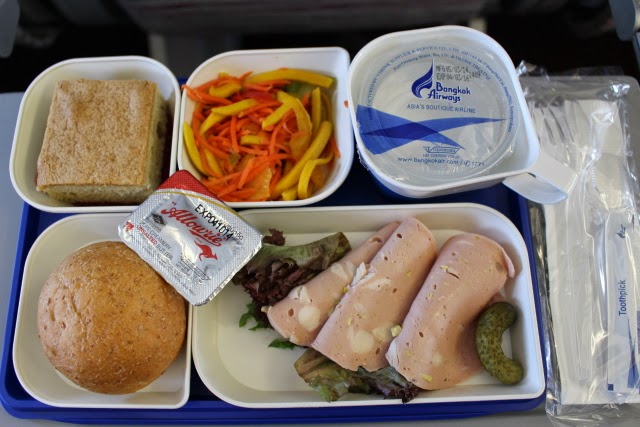
Our meal for the flight. (Photo: Ryosuke Yano)

Although there is no warmed food, Bangkok Air serves a full meal pre-set on trays. Today's menu consisted of a salad, a plate of slices of ham, pickles, vegetables, a bun, raspberry cake, plus a cup of water, which is more than enough for a merely 70-minute flight. Rounds of coffee, tea, water, and orange juice were also offered. At 1205, Captain 'Khun' Manoon made his welcome announcement and informed us we were flying at 32,000 feet. Weather at Bangkok would be partly cloudy with temperatures at 33 degrees Celsius. Five minutes later, our meal trays were collected, and gradual descent into Suvarnabhumi started just a few minutes later.
Airbus A320-232 HS-PPH still retained the seats of former operator TAM. (Photo: Ryosuke Yano)

Our aircraft for this day, HS-PPH, made its maiden flight on April 28th, 2006. The eight-year-old aircraft is one of a batch ordered by Singapore-based BOC Aviation, a subsidiary of Bank of China, and originally started out its career on lease to TAM Airlines (JJ/TAM) wearing the registration PR-MBC. From delivery on May 18, 2006, it spent flying in South American skies from Brazil until being returned to the lessor in August 2013. It was leased to Bangkok Air on December 7th, 2013. At the time we flew, the aircraft was still wearing a basic white scheme (Bangkok Air is famous for their colorful liveries) with only their logo on her tail and small titles in the front, and also still without a name. The A320 also retained 174 seats and its interior from the TAM era.
Flying north along the coast of Gulf of Thailand. (Photo: Ryosuke Yano)

The seat-belt signs were turned on at 1230. We passed over the skyscrapers of Bangkok, or Krung Thep Maha Nakhon in Thai, around 1240 heading north, then making a sharp turn to the right for a final approach to Runway 19L. Gears were lowered at 1246, and we touched down at Suvarnabhumi Airport (BKK/VTBS) three minutes later. We taxied to Gate C5 and came to a stop at 1255, right on schedule. Since Councourse C is in the passport-controlled area, we deplaned to the jet-bridge, only to climb down the stairs to be bused to the domestic arrivals area. 
Inside Bangkok Air's seat pocket was their Fah Thai in-flight magazine as well as their in-flight shopping catalog. The flight attendants gave us notebooks, pens, and stickers. (Photo: Ryosuke Yano)

Bangkok Air is led by President Puttipong Prasarttong-Osoth, whose father Prasert Prasarttong-Osoth owns 92% of the airline as well as heads the Bangkok Hospital Group, one of Southeast Asia's largest private heath-care conglomerates. Founded in 1968 as air-taxi operator Sahakol Air, it became Thailand's first private airline when it launched scheduled passenger services in 1986. Since then, amid the significant growth of LCCs like Thai AirAsia (FD/AIQ) and Nok Air (DD/NOK) and a stronger THAI, the airline has managed to produce profits, thanks to its quasi-monopoly at popular beach destination Samui (USM/VTSM), where the airline privately owns the airport, and their opportunity to code-share with most non-Star Alliance carriers at Southeast Asia's biggest holiday destination.
Thanks to the very friendly cabin crew for a comfortable flight! (Photo: Ryosuke Yano)

The crews were friendly and professional, and from my personal view, more polite than their counterparts at rival THAI, or Thai AirAsia and Nok Air, though the latter two are LCCs and may not be appropriate to compare with. The only negative I could think of was the counter agent unable to register our JAL Mileage Bank numbers. With a modest fleet of seven A320s, a dozen A319s, and eight ATR 72-500s, Bangkok Air is not a very big player, however, they have carved out a niche of their own in the increasingly competitive and crowded market, and certainly live up to their slogan Asia's Boutique Airline.

Friday, June 20, 2014

Skymark to fly Airbus A330s to Sapporo from August.

On June 19th, Skymark Airlines (BC/SKY) announced that their third Airbus A330 will enter service on August 9th. Their first Airbus jetliners, which inaugurated service this past June 14th (Skymark Airlines inaugurates Airbus A330 service.) from Tokyo/Haneda (HND/RJTT) to Fukuoka (FUK/RJFF), will also be assigned to a morning round-trip between Haneda and Sapporo/New Chitose (CTS/RJCC) when the third example is on-line.
Airbus A330-343E JA330B rolls down Runway 16R at Haneda. (Photo: Ryosuke Yano)

During a shareholder's conference, President and CEO Shinichi Nishikubo told investors "A330 flights are showing load factors above 70%," adding "it's beating expectations and we believe our target of 85% could be reached." Japan's third largest carrier has configured their brand-new A330s in a generous 271-seat Green Seat all-premium layout, however, it still represents a 53% capacity increase compared to their Boeing 737-800s, which seat 177 in their all-economy cabin.

In addition, Skymark hopes to launch freight service by the end of the year using belly cargo space of the new wide-body Airbuses. The airline expects the cargo business to bring a 1.5 billion JPY increase in revenue. Meanwhile, an A330 maintenance crew base is being set up in Fukuoka and is hoped to be operational by September to negate the need to send staff in from Haneda whenever an A330 faces technical issues.

Skymark plans a fleet of five A330-300s by the end of this year, with the remaining five to be delivered by August 2015 for a total of 10. Two A330s (JA330A and JA330B) have so far been delivered. They will receive their third (JA330D) in August, fourth (JA330E) in October, fifth (JA330F) in December, while 2015 will see their sixth (JA330G) in February, seventh (JA330K) in April, eighth (JA330L) in June, ninth (JA330M) in July, and tenth (JA330N) in August. Meanwhile, their 737-800 fleet will be reduced to 27 by October 2015; JA737M will be returned to its lessor in September, JA737N in March 2015, and JA737P in October 2015.

After New Chitose, A330 operations will be expanded to Okinawa/Naha (OKA/ROAH) in February or March next year. Skymark expects spare A330s in off-peak travel seasons, especially during the northern winter, and Mr. Nishikubo noted "It would be logical for us to use them on international charters to places like Bali (Indonesia) or Alaska (U.S.A.)." Indeed, their A330s boast fully-equipped galleys for long-haul flights.

Reference: Skymark Airlines, June 13th. (PDF; in Japanese)
Reference: Traicy, June 16th. (in Japanese)
Reference: Aviation Wire, June 19th. (in Japanese) 

*Post edited/updated on June 20th.