Showing posts with label Saab SF340. Show all posts

Tuesday, October 13, 2015

Hokkaido Air System loads Yuzhno-Sakhalinsk charter.

Hokkaido Air System [HC/NTH] announced that they will operate a charter flight between Sapporo/Okadama [OKD/RJCO] and Yuzhno-Sakhalinsk [UUS/UUHS] on the Russian-controlled island of Sakhalin, or Karafuto in Japanese, later this month using its 36-seat Saab SF340B. It will be operated on behalf of the Sakhalin-Hokkaido Economy Mission, a group of local business executives and Hokkaido government officials, including Governor Harumi Takahashi, visiting Sakhalin to strengthen economic ties.

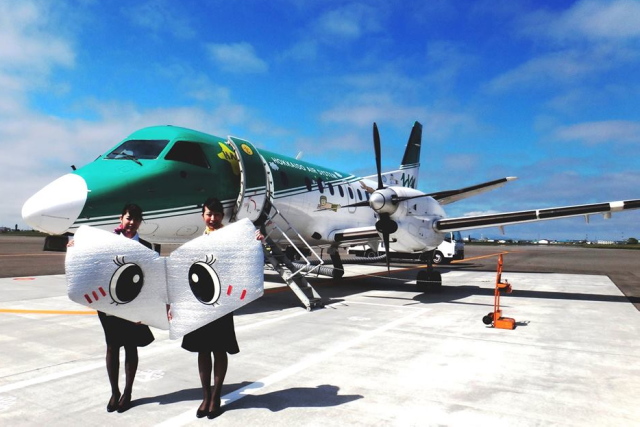
Saab SF340B-WT JA01HC rests between flights at Sapporo's Okadama Airport. It continues to fly in this unique livery, though officially it was scrapped by HAC and replaced by JAL's conventional crane logo effective July 16th to reflect the change in ownership. (Photo: Hokkaido Air System)

Mrs. Takahashi will meet Governor of Sakhalin Oleg Kojemiako to discuss how to promote economic relations and participate in the opening of Hokkaido Center, built by Japanese-Russian joint-venture Hokkaido Developers Group, or HODEG. It will house the Hokkaido branch for Sakhalin.

Flight Schedule:
Okadama – Yuzhno-Sakhalinsk charter with SF340B. 
HC901 OKD 0900 – 1115 UUS SF3 *Oct/22 only charter.
HC102 UUS 1230 – 1245 OKD SF3 *Oct/22 only ferry flight.
HC103 OKD 1400 – 1615 UUS SF3 *Oct/24 only ferry flight.
HC904 UUS 1715 – 1730 OKD SF3 *Oct/24 only charter.

Hokkaido Air System, unofficially but commonly referred to as HAC, became a Japan Airlines [JL/JAL] subsidiary once again after the nation's second largest carrier increased its stake in Hokkaido's commuter airline to 51.23% effective October 23rd, 2014 (JAL raises Hokkaido Air System stake to 51%.). It was originally founded jointly by Japan Air System [JD/JAS] and the Hokkaido Government back in September 1997 to provide high-speed public transportation between the island's major cities as well as the small remote islands.
 
From its hub at Okadama, the smaller but more convenient airport near downtown, HAC currently operates to Hakodate [HKD/RJCH], Kushiro [KUH/RJCK], Misawa [MSJ/RJSM] (CoachFlyer HC330: MSJ - OKD on Hokkaido Air System's Saab SF340.), and Rishiri [RIS/RJER], plus a link to Okushiri [OIR/RJEO] from Hakodate, using a fleet of three SF340Bs. JAL is currently considering using HAC to resume three intra-Hokkaido routes; Hakodate – Kushiro, Hakodate – Asahikawa [AKJ/RJEC], and Okadama – Memanbetsu [MMB/RJCM] (Hokkaido Air System to resume three intra-island routes.).

Source: Hokkaido Government, 2015 October 2nd. (in Japanese)
Source: Hokkaido Air System, 2015 October 2nd. (in Japanese)
Saturday, June 20, 2015

Japan Air Commuter orders up to 23 ATR42-600s.

On June 15th, Japan Air Commuter [3X/JAC] signed a contract to purchase up to 23 ATR42-600s, including eight firm orders, one option, and 14 purchase rights, at the Paris Air Show. Deliveries of the new generation aircraft will begin in 2017 to mainly replace JAC's 10 aging 36-seat Saab SF340Bs. It represents the 1500th ATR aircraft sold since the beginning of the program.

A rendering of the ATR42-600 in Japan Air Commuter's livery. (Image: ATR)

The ATR42-600 turboprop is equipped with a glass cockpit incorporating the newest navigation technologies introduced on the Airbus A380. Seating 48, the aircraft are also equipped with the new Armonia cabin, featuring the latest standards of comfort, including large overhead bins, LED lightening, and more legroom for passengers. JAC President Arata Yasujima said "We evaluated it against a smaller version of the Q400 Bombardier is developing," adding "In the end we valued the ATR42's comfort, economics, and reliability."

Originally a joint-venture (JV) between Japan Air System [JD/JAS] and 12 governments in the Amami Archipelago, controlling 60% and 40%, respectively, the regional airline was founded in 1983 to provide air services to remote islands from Kagoshima [KOJ/RJFK]. The JAS holding has since been inherited by Japan Airlines [JL/JAL] and it currently operates  141 daily flights covering 27 routes. In addition to the SF340Bs, it also flies 11 Bombardier DHC-8-400Qs.

JAC becomes the second carrier in Japan to choose the ATR42 after Amakusa Airlines [AHX], which will take delivery of a single aircraft in January 2016 to replace their sole Bombardier DHC-8-103, JA81MX (Amakusa Airlines chooses ATR42-600.). The Amakusa-based commuter airline started code-sharing with JAL in April (Amakusa Airlines announces code-share with JAL.), and Mr. Yasujima hinted a possible partnership including sharing spare parts sources.

Source: ATR, June 15th. (in English)
Source: Aviation Wire, June 15th. (in Japanese)

Wednesday, May 13, 2015

Hokkaido Air System to resume three intra-island routes.

Hokkaido Air System [HC/NTH] (unofficially referred to as HAC) is planning to resume three intra-Hokkaido routes; Hakodate [HKD/RJCH] – Kushiro [KUH/RJCK], Hakodate – Asahikawa [AKJ/RJEC], and Sapporo/Okadama [OKD/RJCO] – Memanbetsu [MMB/RJCM]. These routes were suspended by January 2013, after Japan Airlines [JL/JAL] reduced its shareholding in the commuter carrier to 14% in March 2011 as part of their restructuring and axed all code-shares. On October 24th, JAL raised that figure back to majority ownership again (JAL raises Hokkaido Air System stake to 51%.).

Saab SF340B-WT JA02HC rests between flights at Misawa. Two of its three airframes still retain JAL Group's old Arc of the Sun livery. (Photo: Ryosuke Yano)

According to an interview by Nikkei Shimbun, Yoichiro Kuwano, HAC's new President effective March 31st did not give any time frame regarding when the resumption would take place. The JAL veteran who came from Operations Management replaced Chihiro Tamura, another JAL manager from the same field.

Meanwhile, Hakodate – Misawa [MSJ/RJSM] is expected to be restarted as early as July as a seasonal service operating on weekends and holidays during the peak summer vacation travel months in cooperation with the parent company. It was initially launched in August 2013 with a daily service, in addition to the daily Okadama – Misawa round-trip (CoachFlyer HC330: MSJ - OKD on Hokkaido Air System's Saab SF340.), but was suspended in December, and though it was resumed in April 2014 operating on weekends and holidays (Hokkaido Air System to resume Hakodate - Misawa.), it was dropped again in November.

FY2014 saw HAC record its highest number of annual passengers at 184,000, a 6% increase over the previous year. "We've been concentrating on maintaining safe and stable operations, and we believe that paid dividends," said Mr. Kuwano, who stressed that that emphasis would continue. Passenger numbers plummeted when the tiny regional airline suffered a landing incident and a maintenance mishap in 2011, which were well-covered by local media. Its system-wide load factor for FY2014 was 62.8%. "Most of our customers use us for business travel, so there should still be lots we could tap into in the leisure market," said Mr. Kuwano, eager to improve that figure. HAC intends to boost sales through increasing promotional fares as well as package tours in conjunction with JAL.

From its hub at Okadama, the smaller but more convenient airport near downtown of Hokkaido's capital, HAC currently operates to Hakodate, Kushiro, Misawa, and Rishiri [RIS/RJER], plus a link to Okushiri [OIR/RJEO] from Hakodate, using a fleet of three 36-seat Saab SF340Bs. Its oldest aircraft is now over 17 years old, and HAC will start considering replacement by the end of FY2015. Sister carrier Japan Air Commuter [3X/JAC] also operates 10 SF340s, and Mr. Kuwano said "The successor would be evaluated together with other JAL group companies."

Source: Nikkei Shimbun, April 23rd. (in Japanese)

Tuesday, December 9, 2014

Hokkaido Air System to fly Happy Air Connection.

Hokkaido Air System [HC/NTH] will operate one of their aircraft, Saab SF340B-WT JA01HC, in a Happy Air Connection special livery as part of a Kushiro City-led campaign to promote the local carrier's Sapporo/Okadama [OKD/RJCO] – Kushiro [KUH/RJCK] service. It will start flying on December 16th and ply the northern skies until the end of March next year.

An image of Saab SF340-WT JA01HC Happy Air Connection. (Image: Hokkaido Air System)

The intra-Hokkaido route is one of a handful Japan's Ministry of Land, Infrastructure, Transport, and Tourism (MLIT) selected for the Rural Air Services Revitalization Program. 36 million JPY worth of grants will be used to offer discounted airport bus tickets as well as publish a free travel magazine to promote the sightseeing spots and restaurants of Kushiro. The special scheme with the message "Go! Go! Kushiro" will also be worn by an airport bus.

During the period, passengers traveling on the route will receive a coupon that could be used to reduce the airport bus fee between Kushiro Airport and the city from 500 JPY to 440 JPY, as well as give a free bus ticket for travel between Okadama Airport and the nearest subway station in Sapporo. A 2,000 JPY discount will also be offered to those using rental cars from Kushiro Airport.

Source: Hokkaido Air System, December 1st. (PDF; in Japanese)
Source: Hokkaido Shimbun, December 3rd. (in Japanese)

Friday, October 24, 2014

JAL raises Hokkaido Air System stake to 51%.

On October 24th, Japan Airlines (JL/JAL) announced that they have completed the repurchase of its shares in Hokkaido Air System (HC/NTH) (unofficially calling itself HAC) which were sold to Hokkaido Government during JAL's bankruptcy reorganization. 31,500 JPY was paid per share, the same price the local government paid JAL in March 2011. JAL's shareholding in HAC increased from 14.49% to 51.23%, making it part of the JAL Group again.
Saab SF340B-WT JA02HC parked at Sapporo Airfield, more commonly called Okadama Airport. Will HAC introduce JAL's latest crane livery? (Photo: Ryosuke Yano)

Yoshiharu Ueki, President of JAL, told that the transaction was completed on October 23rd. Governor of Hokkaido Harumi Takahashi said "For HAC to maintain a safe and stable operation, it is best to fly under JAL. Subsidies are now in place, so we would like them to continue flying island routes and maintain the current network." Mr. Ueki answered "JAL will support HAC to improve its sales performance, strengthen its management competence, and maintain its network. We thank for all the support, and would like to ask for continued assistance."

From its hub at Sapporo/Okadama (OKD/RJCO), the smaller but more convenient airport near downtown, HAC currently operates to Hakodate (HKD/RJCH), Kushiro (KUH/RJCK), Misawa (MSJ/RJSM) (CoachFlyer HC330: MSJ - OKD on Hokkaido Air System's Saab SF340.), and Rishiri (RIS/RJER), plus a link to Okushiri (OIR/RJEO) from Hakodate, using a fleet of three 36-seat Saab SF340Bs. It was originally founded jointly by Japan Air System (JD/JAS) and the Hokkaido Government in September 1997 to provide high-speed public transportation between the island's major cities as well as the small remote islands.

HAC was finally starting to show positive results. For FY2013, total revenue was 2.6 billion JPY (up 21.0% from FY2012), operating profit was 34.9 million JPY (FY 2012 saw a 356.5 million JPY loss), ordinary profit was 64.5 million JPY (296.3 million JPY loss in FY2012), and net income was 138.4 million JPY, as opposed to a 296.2 million JPY loss in FY2012.

Reference: Aviation Wire, October 24th. (in Japanese)

Tuesday, July 15, 2014

Hokkaido Air System to become a JAL subsidiary again.

Japan Airlines (JL/JAL) is moving forward with plans to make Hokkaido Air System (HC/NTH), which calls itself HAC, a subsidiary again by October this year. JAL will increase its shareholding in the struggling commuter carrier from the current 14.5% to 51%.
Saab SF340B-WT JA01HC arrives at Misawa. Will this be short-lived livery? (Photo: Ryosuke Yano)

Majority shareholder Hokkaido Government, which has loans to Hokkaido Air System totaling 360 million JPY, is reported to have agreed in principle to write-off around 100 million JPY of the airline's debts as part of its restructuring. September 2013 saw liabilities exceeding HAC's assets by 136 million JPY. JAL is expected to cover for about 33% of the debt write-off as well.

Meanwhile, HAC will be increasing frequency on the Okadama – Misawa and Okadama – Rishiri (RIS/RJER) routes for the peak Obon homecoming season in August.

Flight Schedule (August 9th - 17th):
Okadama – Misawa 2 daily with SF340B.
HC331 OKD 1005 1105 MSJ SF3 Daily
HC937 OKD 1625 1725 MSJ SF3 Daily *Aug/9-17 only.
HC330 MSJ 1135 1235 OKD SF3 Daily
HC938 MSJ 1755 1855 OKD SF3 Daily *Aug/9-17 only. 

Okadama – Rishiri 2 daily with SF340B.
HC671 OKD 0825 0920 RIS SF3 Daily *Aug/9-17 only.
HC673 OKD 1410 1505 RIS SF3 Daily
HC672 RIS 0950 1045 OKD SF3 Daily *Aug/9-17 only.
HC674 RIS 1535 1630 OKD SF3 Daily

HAC celebrated their first anniversary of the Sapporo/Okadama (OKD/RJCO) – Misawa (MSJ/RJSM) route (CoachFlyer HC330: MSJ – OKD on Hokkaido Air System's Saab SF340.), which was launched on July 1st last year, filling the void left by JAL when they terminated the link in 2007. Load factor from inauguration through May this year was 53.2%, above the break-even line. However, their seasonal Hakodate (HKD/RJCH) – Misawa route, which ran from August to November last year, saw a dismal 10.0%, prompting HAC to change strategy by making it a weekends-and-holidays-only service (Hokkaido Air System to resume Hakodate – Misawa.) from April.

A bigger challenge HAC will need to face this year is All Nippon Airways' (NH/ANA) double-daily Aomori (AOJ/RJSA) – Sapporo/New Chitose (CTS/RJCC) service (ANA returns to Aomori with Osaka and Sapporo flights.), which just inaugurated this past July 1st. JAL already flies the link three-times-daily. The city of Aomori is only a two-hour drive from Misawa.

HAC is currently owned 36.47% by Hokkaido Government, 14.49% by JAL, 13.53% by City of Sapporo, 5.02% by City of Hakodate, 4.74% by Hokkaido Bank, 4.74% by North Pacific Bank, 4.74% by Hokkaido Electric Power, 3.04% by the City of Kushiro, 1.97% by Seicomart, 1.01% by the City of Asahikawa, 1.01% by Hokkaido Chuo Bus, 1.01% by Sapporo Breweries, etc.

Reference: Nikkan Kogyo Shimbun, July 4th. (in Japanese) 
Reference: Yomiuri Shimbun, July 11th. (in Japanese)
Reference: Hokkaido Air System, July 14th. (in Japanese)

Wednesday, June 4, 2014

JAL looks to replace Bombardier CRJs and Saab SF340s.

Japan Airlines (JL/JAL) is considering placing an order for regional airplanes to replace older commuter jets and turboprops, according to an interview with JAL Chairman Masaru Onishi in Doha, Qatar.
Bombardier CL-600-2B19 CRJ-200ER JA208J departs Aomori. (Photo: Ryosuke Yano)

J-Air's (XM/JLJ) nine Bombardier CL-600-2B19 CRJ-200ER and Japan Air Commuter's (3X/JAC) 11 aging Saab SF340Bs are probably the candidates for replacement Mr. Onishi is referring to. J-Air is a wholly-owned subsidiary of JAL, while JAC is controlled 60% by JAL and the remainder by Kagoshima Prefecture and its local governments. The proposal may also include the three SF340Bs of Hokkaido Air System (HC/NTH), in which JAL is expected to increase ownership to 51% during fiscal year 2014.

"The issue will be addressed in the near future," Mr. Onishi stated. Competition for regional jets is likely to involve three companies: Mitsubishi, Embraer, and Bombardier. The Canadian manufacturer and ATR are likely to battle over the turboprop order. Last year, JAL shook the industry by placing a landmark 9.5 billion USD order with the European planemaker for up to 56 Airbus A350 XWBs, including 31 firm examples, to replace their Boeing 777 fleet, after decades of loyalty to the American company.
 
Meanwhile, orders for the A320neo or 737 MAX have been ruled out for the near term, as the airline has judged its 50-strong 737-800 fleet is still in good shape. 70% subsidiary Japan Transocean Air (NU/JTA) also just placed an order for a dozen 737-800s (JTA finalizes order for 12 Boeing 737-800s.) to replace their current 737-400s starting in 2016.

Source: Wall Street Journal, June 2nd. (in English)

Friday, March 7, 2014

Hokkaido Air System to resume Hakodate - Misawa.

Hokkaido Air System's (HC/NTH) new timetable effective April 25th through May 31st sees the revival of Sapporo/Okadama (OKD/RJCO) - Hakodate (HKD/RJCH) - Misawa (MSJ/RJSM) service, though this time it will only be operated on weekends and holidays. The daily non-stop Okadama - Misawa round-trip (CoachFlyer HC330: MSJ - OKD on Hokkaido Air System's Saab SF340.) remains unaffected. 
Saab SF340B-WT JA02HC arrives at Misawa. 'HAC' is their unofficial but preferred three-letter code. (Photo: Ryosuke Yano)

The Okadama - Hakodate - Misawa route was inaugurated on August 1st, 2013, but the Hakodate - Misawa sector was suspended on November 30th due to poor load factors, which are said to have been in the thirties. Staff have pointed out that the high-demand Okadama - Hakodate sector sold out relatively quickly, so passengers from Misawa willing to travel to Okadama could not find a ticket beyond Hakodate. With the new schedule, Hokkaido Air System is deploying a round-trip to add an additional Okadama - Hakodate frequency on weekdays, where there is business demand, while on weekends that round-trip will be used for Hakodate - Misawa.
 
New Routes/Resumptions:
Okadama - Hakodate - Misawa new weekend/holiday service with SF3.
HC337 OKD 1355 - 1435 HKD 1515 - 1550 MSJ SF3 Weekends/Holidays
HC338 MSJ 1625 - 1700 HKD 1730 - 1810 OKD SF3 Weekends/Holidays

Frequency Increases:
Okadama - Hakodate from up to 5 to 6 daily.

Meanwhile, the airline will run a reduced schedule from April 1st to 24th as one of its three Saab SF340B-WTs will undergo heavy maintenance. Frequencies will be cut on routes from Okadama to Hakodate and Kushiro (KUH/RJCK).

Majority shareholder Hokkaido Government, which has loans to Hokkaido Air System totaling 360 million JPY, is reported to have agreed in principle to write-off around 100 million JPY of the airline's debts as part of its restructuring. September 2013 saw liabilities exceeding HAC's assets by 136 million JPY. Japan Airlines (JL/JAL) is currently negotiating with the Hokkaido Government to make the loss-making commuter airline part of the JAL Group again by increasing its shareholding from the current 14.5% to 51%. JAL is expected to cover for about 33% of the debt write-off.

Source: Hokkaido Air System, February 21st. (PDF; in Japanese)
Source: Nikkei Shimbun, February 28th. (in Japanese)

Tuesday, January 14, 2014

CoachFlyer HC330: MSJ - OKD on Hokkaido Air System's Saab SF340.

Travel date: July 2013
Flight: HC330
Route: Misawa (MSJ/RJSM) - Sapporo/Okadama (OKD/RJCO)
Carrier: Hokkaido Air System (HC/NTH)
Aircraft: Saab SF340B-WT JA03HC
Class: Economy
Direct distance: 268 km (167 miles)
Flight time: 48 minutes

Little known outside of Japan, or even the northernmost major island of the Japanese archipelago, Hokkaido Air System (HC/NTH), often unofficially referred to as HAC ("H"okkaido "A"ir System "C"o., Ltd.), has been plying regional intra-Hokkaido routes since 1998. Originally founded jointly by Japan Air System (JD/JAS) and the Government of Hokkaido in September 1997, it was formed to provide high-speed public transportation between its major cities as well as the satellite islands in this by far the biggest and most rural prefecture of Japan. Acronym HAC was chosen over HAS to avoid confusion with a company named Hokkaido Air Services, which was based at Sapporo/New Chitose (CTS/RJCC) running food and souvenir shops. Operations were launched in March 1998 connecting Hakodate (HKD/RJCH), the third biggest city in Hokkaido, with Asahikawa (AKJ/RJEC), the second biggest, and Kushiro (KUH/RJCK) using Saab SF340Bs. However, losses quickly mounted, and the airline kept on borrowing cash from the Hokkaido government.
Saab SF340B-WT JA01HC, the only aircraft so far in the new livery, at Okadama. (Photo: Ryosuke Yano)

HAC's aircraft wore JAS's rainbow colors until JAS was merged into Japan Airlines (JL/JAL) in 2002, when they adopted the 'Arc of the Sun' livery. In 2010, owing to JAL's financial troubles, the parent decided to pull out of managing HAC, and after a heavily-negotiated deal, all but 14% of its shares were transferred to municipalities HAC served and Hokkaido's local businesses in March 2011. Shut-down was avoided and HAC received another 1 billion JPY injection from the Hokkaido government, enabling them to simplify its operations by abandoning New Chitose and concentrating on Sapporo's downtown Okadama (OKD/RJCO), introduce a new livery, and launch its own reservations system (it had relied on JAL).
View from HC330, northbound. (Photo: Ryosuke Yano)

However, coupled with a landing incident and a maintenance mishap that were well covered by the media, together with transition costs, HAC continued to bleed cash and in February 2012, declared a balance cash insolvency, with cash reserves of just 4 million JPY and a record 560 million JPY loss for fiscal year ending in March 2012. After hiring various accounting firms to analyze HAC's assets and help lay a Plan B, Hokkaido decided to cover for at least 200 million JPY of the losses and lend more cash, and hired former JAL Safety Operations Manager Chihiro Tamura as President to implement a new road to recovery. Route rationalization came and operations at Asahikawa and Memanbetsu (MMB/RJCM) were closed down by January 2013, meanwhile increasing frequency on the relatively profitable Okadama -Hakodate and Okadama - Kushiro routes.
Inside the seat pocket. FLY HAC is their hand-made magazine. (Photo: Ryosuke Yano)

Seeing an only intra-Hokkaido network as limited for growth, HAC ventured outside of Hokkaido for the first time in a decade, when they launched Okadama - Misawa (MSJ/RSJM), in eastern Aomori prefecture on July 1st. Misawa itself had lost a connection to Hokkaido when JAL pulled out of that route in 2007. So I and my wife booked on flight HC330 from Misawa to Okadama to taste the reborn HAC. Arriving at the airport's free parking lot (just a two-minute walk farther than the charged one), we were already checked-in at 1110. Other than HAC, JAL is the only airline serving Misawa, having inherited the destination from the merger with JAS in 2002, with three flights from Tokyo/Haneda (HND/RJTT) and a single flight from Osaka/Itami (ITM/RJOO), both daily, so naturally, JAL provides check-in and ground handling for HAC here. As space is limited on the 36-seat turboprop, carry-on baggage is limited to one piece within 35 x 45 x 20cm and 10kg, and a check-in baggage allowance of one suitcase within 120 x 60 x 50cm and 20kg is provided. With no two flights departing at the same time, security was a breeze, and boarding started at 1125. 
The cabin of HAC's Saab SF340B. (Photo: Ryosuke Yano)

As it's a SF340, we boarded from the apron. At 1134, the door was closed and engines were started, and we were moving on our own at 1144, nine minutes behind schedule. As we reached the threshold of Runway 10, the captain told us that we would be on hold for nearly 10 minutes to wait for an incoming military aircraft. Misawa shares its single runway with the adjacent Japan Self Defense Force (JSDF) and U.S. Air Force (USAF) bases. So it was not until 1157 that we took off from Runway 10, immediately banking left and heading north along the shore. Seat-belt signs were turned off at 1205, and four minutes later, the single flight attendant started handing out blankets followed by candies. Bottled water and green tea were available when requested. Young fliers received a small airplane toy, a picture book, along with a small packaged snack. HAC has its own in-flight magazine named 'FLY HAC', all hand-made by its employees, giving passengers the impression of a small family-run airline. Its staff write articles about the sightseeing spots and local cuisines at the airline's destinations, print them, and bind them in a transparent plastic folder. 
Aomori's Shimokita Peninsula seen from the southbound flight back to Misawa. (Photo: Ryosuke Yano)

Captain Sakamoto made his announcement at 1212, apologizing for the delay and reported that we were cruising at 4,600m (15,000ft) at 470kph (290mph). We had a smooth cruise, however, the clouds below us were thick, obstructing what would be a beautiful scenery of Aomori's Shimokita penninsula and Hokkaido's vast land and picturesque mountains (I did get a spectacular view on the way back to Misawa. Photos posted!). At 1225, the flight attendant announced that we would be descending soon, and started collecting anything we would like to discard. Seven minutes later, we had begun our descent. Seat-belt signs were turned on at 1236 and we flew right over and passed Sapporo city, heading north then making a sharp turn to the right, for a final approach to Okadama. We touched down on Runway 14 at 1245, and came to a stop in front of the compact terminal three minutes later, 13 minutes behind schedule. Total flight time was 48 minutes. 
Lake Toya seen from the southbound flight back to Misawa. (Photo: Ryosuke Yano)

We deplaned to the tarmac and walked to the terminal building, and our baggage was out in just a few minutes. Okadama's simple terminal consists of three floors; the arrivals hall and check-in counters are on the first, the departures hall along with a restaurant and souvenir shop are on the second, and an observation deck is on the third. The Sakae-machi subway station is a five-minute bus ride from the airport, and from there would take 12 minutes to downtown Sapporo. New Chitose, the much larger main international airport serving Sapporo, is a 40-minute express-train ride or a 1.5-hour bus ride from downtown. Although HAC has been the sole user of Okadama since 2010, when ANA subsidiary Air Nippon Network (EH/AKX) left to concentrate on New Chitose (the opposite of what HAC did), Fuji Dream Airlines (JH/FDA) conducted a test flight to Okadama from Nagoya/Komaki (NKM/RJNA) in July with an Embraer ERJ170 and has announced its intention to start seasonal and charter operations, leveraging the airport's proximity to downtown. Year-round jet operations are still thought to be difficult, unless the 1,500m runway is extended. 
Mt. Yotei seen from the southbound flight back to Misawa. (Photo: Ryosuke Yano)

HAC now operates five Okadama - Hakodate round-trips, four Okadama - Kushiro round-trips, and a round-trip each for Okadama - Misawa, Hakodate - Misawa (seasonal), Okadama - Rishiri (RIS/RJER), and Hakodate - Okushiri (OIR/RJEO), with a trio of Saab SF340Bs. Its ownership portfolio includes Hokkaido Government with 36.47%, JAL with 14.49%, City of Sapporo with 13.53%, City of Hakodate's 5.02%, Hokkaido Bank's 4.74%, North Pacific Bank's 4.74%, Hokkaido Electric Power's 4.74%, City of Kushiro's 3.04%, Seicomart's 1.97%, City of Asahikawa's 1.01%, Hokkaido Chuo Bus' 1.01%, Sapporo Breweries' 1.01%, etc. In July, HAC restarted code-sharing with JAL, and for the first time launched its own frequent-flyer program 'HAC Flight Points', where passengers can get a point effective for two years for a one-way ticket; six points can be redeemed for a model airplane, 12 for a one-way ticket, and 24 for a round-trip ticket.
Okadama's compact terminal seen from the tarmac. (Photo: Ryosuke Yano)

Together with offering more fare choices and running promotions, HAC reported for August 2013 (high season; Obon homecoming month) passenger numbers increasing by 28.6% and a load factor increase of 19.4% to 71.8% compared to one year ago. The newly-launched Okadama - Misawa route also had 69.3%. The 2013-2014 end-of-the-year-to-new-year holiday season saw a system-wide load factor of 64.3%, with the Okadama - Misawa route producing a similar figure. Being profitable in providing local commuting services in rural areas is not an easy mission, but it is certainly a necessary means of travel in Hokkaido where fast and frequent trains ubiquitous in other parts of Japan are almost non-existent, and what would be a several hours car drive could be reduced to merely a half-to-one-hour hop. Years of dependency on JAS (and later JAL) and subsidies from local governments brought about operational inefficiencies and slow-to-respond management, however, the financial difficulties of JAL and HAC itself now having one leg in the grave, HAC is finally making changes. Exploring opportunities beyond Hokkaido has been just one of many.
HAC's check-in counters at Okadama. (Photo: Ryosuke Yano)

In a surprise move on September 18th, JAL announced intentions to re-invest in HAC and bring its ownership up to 51% as early as 2014, together with plans to restart up to 10 rural routes that were abandoned during its restructuring. Whether those who believed could turn HAC around by themselves are sighing, or those who thought of demise as unavoidable are relieved, is not sure, as some analysts viewed the announcement as JAL's tactic to get the bigger share of additional international slots at Haneda being allocated from March, 2014. Investing in public transportation in rural areas is one of the many factors considered by the government when allocating slots at the heavily-regulated airport. Eventually, on October 2nd, 2013, ANA received 11 and JAL just five of the additional daily daytime international slots, which led to JAL strongly criticizing the government and requesting clarification about the decision process. 
Our JA03HC at Okadama. It still wears JAL's 'Arc of the Sun' livery. (Photo: Ryosuke Yano)

Whatever the outcome of JAL's planned re-involvement, HAC is still clinging to its life after two major near-bankruptcies, and recent efforts and positive results are having itself and especially local governments in Hokkaido hoping for a third-time lucky.