Showing posts with label CoachFlyer. Show all posts

Tuesday, September 2, 2014

CoachFlyer: THAI retires the Airbus A300 - Part II.

Continued from CoachFlyer: THAI retires the Airbus A300 - Part I.

On July 31st, Thai Airways International (TG/THA), or simply THAI, officially retired the Airbus A300 from service, ending over 36 years of operations. The final flight was TG045, service from Khon Kaen (KKC/VTUK) to Bangkok/Suvarnabhumi (BKK/VTBS), which was operated by their ultimate aircraft A300B4-622R HS-TAZ Srisubhan.
Airbus A300B4-622R HS-TAZ Srisubhan at Khon Kaen on the last day before her final flight back to Bangkok's Suvarnabhumi as TG045. (Photo: THAI)

THAI's first of the type was A300B4-103 HS-TGH Srimuang, which was delivered on October 25th 1977 and introduced a few weeks later, while the first of the modernized 'A300-600' series was delivered on September 26th, 1985 with A300B4-601 HS-TAA Suwannaphum.
Airbus A300B4-622R HS-TAW Suranaree rotates from Khon Kaen in February 2014. She was decommissioned on May 31st. (Photo: Ryosuke Yano)

The flag carrier acquired a total of 33 A300s (C4-203 x1, B4-103 x7, B4-203 x4, B4-601 x6, B4-605R x2, B4-622R x13) directly from the European manufacturer, forming the backbone of the regional fleet serving trunk intra-Asian routes, and briefly leased two others as well. It covered the Middle East to the west and Japan to the east.
Airbus A300B4-622R HS-TAZ Srisubhan receives the traditional water-cannon salute. (Photo: THAI)

However, since the introduction of the Airbus A330s and Boeing 777s as well as the transferring of more regional routes to Nok Air (DD/NOK) and Thai Smile Airways (WE/THD), their roles have gradually been relegated and by July 2014 the type served just four destinations; Chiang Mai (CNX/VTCC), Hanoi/Noi Bai (HAN/VVNB), Khon Kaen, and Krabi (KBV/VTSG).

Crews of the Airbus A300 disembark HS-TAZ Srisubhan. (Photo: THAI)

The final flight from Hanoi was operated on July 30th as TG565, while the morning of July 31st saw the type leaving Chiang Mai and Krabi for the last time as TG123 and TG242, respectively, leaving the flight to and from Khon Kaen to be the last.
The men who piloted THAI's Airbus A300s. (Photo: THAI)
 
By July, its fleet of A300s had also been reduced to just the ultimate three; HS-TAX Thepsatri, HS-TAY Srisoonthorn, and HS-TAZ Srisubhan. HS-TAT Srimuang flew its last revenue flight on June 30th as TG047 Khon Kaen – Suvarnabhumi and HS-TAW Suranaree on May 31st as TG557 Ho Chi Minh/Tan Son Nhat (SGN/VVTS) – Suvarnabhumi. HS-TAX was retired after TG047 Khon Kaen – Suvarnabhumi on July 19th and HS-TAY on July 30th as TG047 as well.
Airbus A300B4-622R HS-TAT Srimuang also participated in the ceremony. (Photo: THAI)

At Khon Kaen on the last day, enthusiasts took advantage of photo opportunities as the aircraft was parked away from the jet-bridge and boarding took place from the apron, which was done for the last flight. The aircraft departed the northeastern transport hub 30 minutes behind schedule at 1255 and took off from Runway 21. It touched down at Suvarnabhumi's Runway 19L after a flawless flight at 1355.
Farewell messages on the aircraft. (Photo: THAI)

Upon arrival at a remote parking spot, passengers disembarked via the airstairs to be greeted by a flock of THAI A300 pilots who were waiting for the arrival. After all customers had deplaned, staff and all of the A300 team boarded the aircraft for a taxi to the airline's hangar on the east side of the airport for the retirement ceremony.
Door closed for the last A300 HS-TAZ Srisubhan. The moment the AB6 became a legend. (Photo: THAI)

As it moved on its own power, it received a water-cannon salute moments before coming to a stop where two sisters were waiting; HS-TAW Suranaree and HS-TAX Thepsatri. The door was opened and all the A300 crew started disembarking the aircraft, beginning the 'closing door ceremony'. After all had deplaned, the L1 door was closed and a ribbon was placed on it. Everyone at the site signed the airplane.
Farwell THAI Airbus A300. (Photo: THAI)

A farewell ceremony took place in the hangars with THAI employees as well as THAI Fan Club members participating. You will be missed, goodbye THAI AB6: The Legend of the Sky.

Reference: Thai Airways International @ Facebook.

Monday, September 1, 2014

CoachFlyer: THAI retires the Airbus A300 - Part I.

It would be a day for me to remember, as it was my last flight on an Airbus A300 operated by Thai Airways International (TG/THA) (THAI), or probably by any carrier, as the type has now been phased out from most of the major airlines. It was just a few days before the national carrier retired the type on July 31st.
Airbus A300B4-622R HS-TAZ Srisubhan departs from rainy Khon Kaen as TG045 for her return leg to Bangkok's Suvarnabhumi in July 2014. (Photo: Ryosuke Yano)

I have flown dozens of times on THAI's venerable widebody twin-jet, mostly between Bangkok/Suvarnabhumi (BKK/VTBS) and Khon Kaen (KKC/VTUK), but to some other cities as well. The short link connecting the northeastern transport hub and the capital is merely a 40-minute flight covering a direct distance of just 377 kilometers (234 miles), the shortest on the flag carrier's network. It being one of the last A300 routes is a testament to the aircraft's capability as a high-capacity, short-to-medium-range airliner, which is what garnered so much popularity in Asia for trunk regional routes.
HS-TAZ's economy class cabin. (Photo: Ryosuke Yano)

Boarding for flight TG044 started at hazy Suvarnabhumi's Gate B3 at 1015 (TST), 30 minutes before departure time, starting with handicapped passengers, followed by Royal Orchid Plus Gold and Star Alliance Gold holders. General boarding commenced five minutes later. I found my seat at 49A, just behind the L3 door. THAI configured their A300-600s with 46 Royal Silk Class, the airline's business class product (BusinessFlyer TG041: KKC – BKK on Thai Airways International's Airbus A300.) and 201 economy seats.
Flying over Nakhon Ratchasima province. (Photo: Ryosuke Yano)

Doors were closed at 1041, however, heavy rain started pouring soon after, and coupled with runway congestion, we were told our departure would be delayed by 15 minutes. It was not until 1107 that we were finally pushed back, 22 minutes behind schedule. We crossed the airport to the west side, making our way to the threshold of Runway 19R. We lifted off at 1125. After banking to the left towards east then heading north, the seat belt lights were turned off seven minutes after takeoff.
THAI's snack box and inside the front seat pocket. Sawasdee is their in-flight magazine. Duty free is not offered on domestic flights. (Photo: Ryosuke Yano)

Our aircraft for today was A300B4-622R HS-TAZ Srisubhan, THAI's ultimate A300, which was only delivered on November 30th, 1998, not too old and actually newer than their first batch of eight A330-300s. It was piloted by Captains 'khun' Pornchai and 'khun' Wattana. Soon after we had reached 3,050 meters (10,000 feet), the flight attendants quickly walked to the galleys to prepare for in-flight service. We were served a snack box, which THAI does on all domestic flights, followed by rounds of hot tea, coffee, orange juice, and water.
The screen and R3 door. (Photo: Ryosuke Yano)

Only 10 minutes later around 1145, the cabin crew started collecting trash, and as they were busy with that, HS-TAZ started its descent. We were past Nakhon Ratchasima. As we lowered our altitude, the farmlands of Isan, or the Thai northeast started to appear below us. At 1155, the seat belt lights were turned on, and with the gears down at 1202, we touched down on Khon Kaen's Runway 03 at 1208. Total flight time was 43 minutes. We taxied and came to a stop at Gate 1 at 1214, 34 minutes behind the published time.
HS-TAZ's toilet. (Photo: Ryosuke Yano)

Khon Kaen has become a much busier airport, in parallel with the city's growth. It had only three daily THAI round-trips between Bangkok only four years ago, but now accommodates two THAI flights to Suvarnabhumi as well from Don Mueang (DMK/VTBD), Bangkok's older airport, are three Thai Smile Airways (WE/THD) round-trips, four Thai AirAsia (FD/AIQ) flights, and two Nok Air (DD/NOK) services. It is also linked with Chiang Mai (CNX/VTCC) by Kannithi Aviation (d.b.a. Kan Air) (K8/KND), while Lao Central Airlines (LF/LKA) runs seasonal international charters to and from Luang Prabang (LPQ/VLLB).
Final approach into Khon Kaen, passing over the fields and villages of Isan. (Photo: Ryosuke Yano)

Although I spent some time to take photos from the adjacent parking lot, which offers an unobstructed view of the apron, I later traveled to the now bustling city to shop some things and get business done before my return flight to Suvarnabhumi in the evening. Downtown Khon Kaen is about a 15-minute taxi ride from the airport, costing around 200 THB.
Khon Kaen Airport now sees up to 12 round-trips per day. (Photo: Ryosuke Yano)

I arrived back at the airport around 1830, and after checking in, went outside to the parking lot again, to wait for the A300 to come in. At 1920, the aircraft thundered down the runway with its thrust reversers deployed to good effect. It was A300B4-600R HS-TAX Thepsatri, THAI's third-from-the-last A300, which was delivered to the airline back on December 10th, 1998. THAI's last five A300s were all delivered near the end of 1998, making them roughly 15.5 years old at the time of retirement.

Airbus A300B4-622R HS-TAX Thepsatri arrives at drizzling Khon Kaen as TG046 from Suvarnabhmi in July 2014. (Photo: Ryosuke Yano)

Priority boarding started for TG047, service back to Suvarnabhumi, at 1938, followed by general boarding four minutes later. Knowing it would be my last had me filled with deep emotions; it was not like any other A300 flight I had taken in the past. I boarded and this time my seat was 36A, near the left Pratt & Whitney PW4158 engine. Doors were closed at 1955, and we were pushed back at 1959, a minute ahead of schedule. However, we had to hold short of the runway to wait for a Nok Air Boeing 737 and a Thai AirAsia Airbus A320 to come in, both arriving in from Don Mueang.
The cheerful flight attendants on TG047. (Photo: Ryosuke Yano)

At 2011, we took off from Runway 03, and as we climbed we banked to the left heading south, with the city lights of Khon Kaen clearly visible. Only six minutes later, the seat belt signs were turned off and again as always, the crew started the in-flight service immediately. Snack boxes were handed out, followed by rounds of hot and cold beverages. At 2023, Captains khun Bhudhibhuntu and khun Poonlap made their announcement welcoming passengers and that the aircraft was cruising at 11,580 meters (38,000 feet) at 800 kph (500 mph).
Food carts on board. (Photo: Ryosuke Yano)

I had a chance to chat with the cabin crew, who told me that for some this would be the last flight too. "It's a classic aircraft," said khun Patiphat, adding "She has worked so hard for so many years. She's like our teacher, as for all of us she was our first aircraft to fly." As they reminisced of some fond memories, the aircraft started its descent at 2029. Soon after at 2037 the seat belt lights were turned on and I returned to my seat. It was a rather bumpy descent.
Its classic dispensers. (Photo: Ryosuke Yano)

As we flew over Nakhon Nayok and Samut Prakan provinces and its extensive rice fields, we gradually lowered our altitude. Flaps were down at 2046, followed by the gears a minute later, and we quietly touched down on Runway 19R at Suvarnabhumi at 2050. Our total time in the air was a mere 39 minutes. We taxied to Gate B1, where we came to a stop at 2103. It would probably be my last landing on an A300.
Final approach into Bangkok's Suvarnabhumi. (Photo: Ryosuke Yano)

I learned that this became the last flight for Thepsatri, as this aircraft was retired after this leg. After most passengers had disembarked, I took a few moments to glance at the classic cabin, to spend some time and say my one last thanks to the airplane that carried me so many times. She was certainly a workhorse for THAI and for the so many passengers it carried over the years, including myself.
Captains khun Bhudhibhuntu and khun Poonlap of TG047. (Photo: Ryosuke Yano)

I stepped slowly outside, and after I was in the terminal, I went to the windows to gaze at the A300 once last time. Khop khun maak, and chok dii na khrap! Farewell THAI A300. The final day of A300 operations came just a few days later on July 31st.

Continues to CoachFlyer: THAI retires the Airbus A300 - Part II.

Tuesday, June 24, 2014

CoachFlyer PG284: HKT – BKK on Bangkok Air's Airbus A320.

Travel date: March 2014
Flight: PG284
Route: Phuket (HKT/VTSP) – Bangkok/Suvarnabumi (BKK/VTBS)
Carrier: Bangkok Airways (PG/BKP)
Aircraft: Airbus A320-232 HS-PPH
Class: Economy 
Direct distance: 672 kilometers (417 miles)
Flight time: 1 hour 11 minutes
Sistership Airbus A320-232 HS-PPD Flying Bags lines up for departure at hazy Suvarnabhumi. (Photo: Ryosuke Yano)

Knowing that we would be encountering traffic congestion around the airport, we arrived at 1000, about half an hour before departure time, to return our rental car. Inconveniently, some rental car offices are only located inside the arrivals hall just outside the baggage claim, so we needed to get ourselves checked before we literally back-tracked to that area.  
Bangkok Air's check-in counters in domestic Terminal 2. (Photo: Ryosuke Yano)

Phuket International Airport (HKT/VTSP) is Thailand's third busiest airport, processing 11.3 million passengers in 2013. Terminal expansion has not been able to catch up with the growth; parking space is scarce and the relatively small and old Terminal 1 and 2, catering for international and domestic, respectively, is long overdue for a replacement. A new international terminal planned for 2015 is currently under construction, and the current two terminals will receive a renovation and serve domestic flights. 
The congested departures area beyond security check. (Photo: Ryosuke Yano)

Check-in counters are located on the second floor and we were checked in at Bangkok Airways' (PG/BKP) (often shortened to simply Bangkok Air) counters by 1020. Since we had bought a promotion fare, our baggage allowance was limited to 20 kilograms per person, and with our suitcases weighing 25 kilograms each (bought lots of local packaged foods), we had to pay 80 THB per kilogram overweight. Bangkok Air and Japan Airlines (JL/JAL) recently started partnering with reciprocal mile accrual and redemption, but the staff at the counter was unaware and it took us some time for the counter agent to register our JAL Mileage Bank numbers. And even so, it later turned out that it wasn't logged, and we had to call JAL and send them our tickets after returning to Japan to have our miles accrued.
Bangkok Air's Boutique Lounge at Phuket. (Photo: Ryosuke Yano)

However, a nice thing was that since my wife was pregnant, they kindly placed us in the front section of the all-economy cabin and blocked off the middle seat for us. The departures hall was packed with people, so we decided to move on to security, located in the southern end of the building for domestic flights. We passed through at 1030. It wasn't busy, but there weren't any priority lanes available. We then headed to Bangkok Air's lounge located in the farthest corner of the domestic departures hall, adjacent to rival Thai Airways International's (TG/THA) (THAI) Royal Silk Lounge. Bangkok Air touts itself as Asia's Boutique Airline, and one of the noteworthy positives is that they offer a lounge to all passengers. It offers plenty of western snacks and drinks, as well as a descent selection of Thai and English newspapers.
Our Airbus A320-232 HS-PPH. Still mostly white and without a name. (Photo: Ryosuke Yano)

Boarding started at 1100 at Gate 66B, and they split the load into two groups according to their seats to make the process less chaotic; Zone 2 (Rows 14-28) boarded first, followed by Zone 1 (Row 1-12). We climbed down the stairs, where a bus was waiting to carry us to Spot 2, near the eastern end of the apron, where Airbus A320-232 HS-PPH was parked. We boarded using the airstair. Our seats were in row two, and in row one was a buddhist monk dressed in a typical saffron robe. Doors were closed at 1121 and as the cockpit crew were making their final check-ups, the cabin crew went through the cabin to hand out refreshing towels. Push back started at 1125, five minutes ahead of schedule, and we were moving on our own in four minutes.
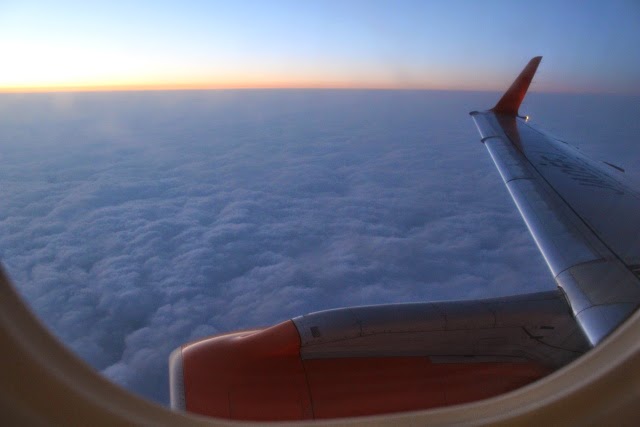
Climbing above the hills of Koh Phang Nga province. (Photo: Ryosuke Yano)

Albeit the early departure, we had to wait at the threshold of Runway 9 to wait for two incoming aircraft; a Dragonair (KA/HDA) Airbus A321 from Hong Kong and a private jet. Phuket Airport is equipped with only one runway, and located in an isthmus-like area of the island between the hills to the north and south, there is no room for another. With our two IAE V2527-A5 engines roaring, we finally took off at 1139 and banked to the left heading north, flying over the rocky islands made of limestone of Phang Nga province. Four minutes after takeoff, the seat-belt lights were turned off and the flight attendants started their in-flight services just a few minutes later.
Our meal for the flight. (Photo: Ryosuke Yano)

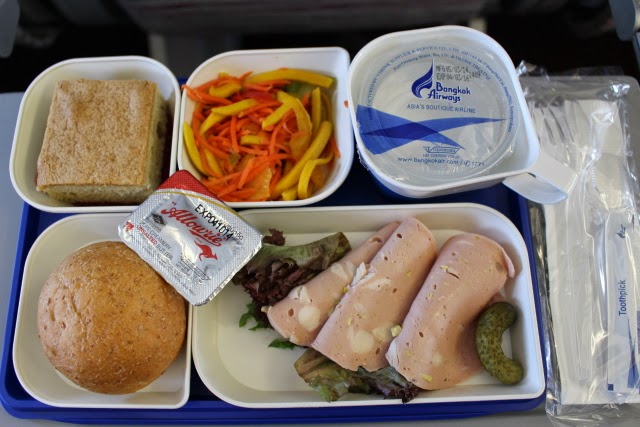
Although there is no warmed food, Bangkok Air serves a full meal pre-set on trays. Today's menu consisted of a salad, a plate of slices of ham, pickles, vegetables, a bun, raspberry cake, plus a cup of water, which is more than enough for a merely 70-minute flight. Rounds of coffee, tea, water, and orange juice were also offered. At 1205, Captain 'Khun' Manoon made his welcome announcement and informed us we were flying at 32,000 feet. Weather at Bangkok would be partly cloudy with temperatures at 33 degrees Celsius. Five minutes later, our meal trays were collected, and gradual descent into Suvarnabhumi started just a few minutes later.
Airbus A320-232 HS-PPH still retained the seats of former operator TAM. (Photo: Ryosuke Yano)

Our aircraft for this day, HS-PPH, made its maiden flight on April 28th, 2006. The eight-year-old aircraft is one of a batch ordered by Singapore-based BOC Aviation, a subsidiary of Bank of China, and originally started out its career on lease to TAM Airlines (JJ/TAM) wearing the registration PR-MBC. From delivery on May 18, 2006, it spent flying in South American skies from Brazil until being returned to the lessor in August 2013. It was leased to Bangkok Air on December 7th, 2013. At the time we flew, the aircraft was still wearing a basic white scheme (Bangkok Air is famous for their colorful liveries) with only their logo on her tail and small titles in the front, and also still without a name. The A320 also retained 174 seats and its interior from the TAM era.
Flying north along the coast of Gulf of Thailand. (Photo: Ryosuke Yano)

The seat-belt signs were turned on at 1230. We passed over the skyscrapers of Bangkok, or Krung Thep Maha Nakhon in Thai, around 1240 heading north, then making a sharp turn to the right for a final approach to Runway 19L. Gears were lowered at 1246, and we touched down at Suvarnabhumi Airport (BKK/VTBS) three minutes later. We taxied to Gate C5 and came to a stop at 1255, right on schedule. Since Councourse C is in the passport-controlled area, we deplaned to the jet-bridge, only to climb down the stairs to be bused to the domestic arrivals area. 
Inside Bangkok Air's seat pocket was their Fah Thai in-flight magazine as well as their in-flight shopping catalog. The flight attendants gave us notebooks, pens, and stickers. (Photo: Ryosuke Yano)

Bangkok Air is led by President Puttipong Prasarttong-Osoth, whose father Prasert Prasarttong-Osoth owns 92% of the airline as well as heads the Bangkok Hospital Group, one of Southeast Asia's largest private heath-care conglomerates. Founded in 1968 as air-taxi operator Sahakol Air, it became Thailand's first private airline when it launched scheduled passenger services in 1986. Since then, amid the significant growth of LCCs like Thai AirAsia (FD/AIQ) and Nok Air (DD/NOK) and a stronger THAI, the airline has managed to produce profits, thanks to its quasi-monopoly at popular beach destination Samui (USM/VTSM), where the airline privately owns the airport, and their opportunity to code-share with most non-Star Alliance carriers at Southeast Asia's biggest holiday destination.
Thanks to the very friendly cabin crew for a comfortable flight! (Photo: Ryosuke Yano)

The crews were friendly and professional, and from my personal view, more polite than their counterparts at rival THAI, or Thai AirAsia and Nok Air, though the latter two are LCCs and may not be appropriate to compare with. The only negative I could think of was the counter agent unable to register our JAL Mileage Bank numbers. With a modest fleet of seven A320s, a dozen A319s, and eight ATR 72-500s, Bangkok Air is not a very big player, however, they have carved out a niche of their own in the increasingly competitive and crowded market, and certainly live up to their slogan Asia's Boutique Airline.

Sunday, May 25, 2014

CoachFlyer JH366: AOJ – NKM on Fuji Dream Airlines' Embraer E175.

Travel date: March 2014
Flight: JH366
Route: Aomori (AOJ/RJSA) – Nagoya/Komaki (NKM/RJNA)
Carrier: Fuji Dream Airlines (JH/FDA)
Aircraft: Embraer ERJ170-200/STD (E175) JA05FJ 'Orange'
Class: Economy
Direct distance: 692 km (430 miles)
Flight time: 1 hour 6 minutes

Blizzard was the weather when I had to take Fuji Dream Airlines (JH/FDA) from Aomori to Nagoya. It was around -6 degrees Celsius and the winds were very strong, with snow gusts often obstructing our front view while driving my car to the airport, prompting all drivers to travel at a much slower speed than usual. And with Aomori Airport (AOJ/RJSA) literally located on top of a mountain where snow and wind is worse, I was obviously worried if my airplane would be able to land.
Our Embraer ERJ170-200/STD (E175) JA05FJ 'Orange' landing in snowy Aomori, with its thrust reversers deployed to good effect. (Photo: Ryosuke Yano)

I managed to arrive at the airport at 1530, briefly ahead of my flight JH366's scheduled departure time of 1610. FDA's flights at Aomori are handled by partner JAL, though they don't code-share on the Aomori route for complicated reasons. Upon checking in, I was notified that the airplane was still scheduled in to arrive, albeit a few minutes late. Baggage allowance is generous at three pieces per person and up to 15 kilograms per piece, though 600 JPY is charged for every one kilogram overweight. I went up to the observation deck only to see the strong blizzard, and made me worried even more hearing the announcement that JAL's flight from Osaka/Itami (ITM/RJOO), operated by commuter subsidiary J-Air (XM/JLJ), couldn't arrive and would be diverting to Sendai (SDJ/RJSS). But no announcement about FDA. 
A gallery showing how Aomori's 'White Impulse' snow plowers work. (Photo: Ryosuke Yano)

Visibility was around 500 meters. I watched the threshold of Runway 24 closely, and as I was hoping it could arrive, an orange E-Jet suddenly appeared from the white sky and came in for a touchdown at 1553, throwing runway snow up in the air. Plagued with thick fog in the spring and blizzards in the winter, Aomori Airport was upgraded to ILS Category IIIa in 2007 and IIIb in 2012, one of only seven airports in Japan equipped so. I went down to the second floor and passed through security, where a huge crowd was waiting. The airport announced its decision to mobilize their 'White Impulse' airport snow-plowing team, and the plowing process would take 40 minutes. So our flight was given a new departure time of 1700, while JAL's flights to Itami and Tokyo/Haneda (HND/RJTT) were also delayed. Their flight to New Chitose was unfortunately canceled, as the aircraft from Itami could not arrive into the airport.
Our aircraft 'Orange' taxiing slowly to the gate. (Photo: Ryosuke Yano)

Boarding started for our flight at 1645 starting with priority passengers; handicapped persons, pregnant mothers, and groups with small children. FDA doesn't offer a premium product, so soon after, all others were boarding. At 1651, the doors were closed, but were told that we had to wait for de-icing. While we were waiting, the cabin crew performed a manual safety demonstration, as there are no screens equipped on this aircraft, along with a recorded explanation in Japanese and English. After that, they handed out blankets. At 1705, Captain Tatsunami-san told us that we were in line for de-icing; JAL's flight to Haneda was first, then us, followed by J-Air's Itami flight. Everyone seemed to be reading a book or newspaper, or sleeping, and as we were waiting the two cabin attendants handed out handmade Baba-Seika candies from Shizuoka. Our turn for de-icing finally came at 1715, and finished in about 15 minutes. We were pushed back at 1731, and turning our engines on, we were moving on our own six minutes later heading for the threshold of Runway 24.
JAL is responsible for de-icing FDA's aircraft. (Photo: Ryosuke Yano)

Thrust of the two General Electric CF34-8E engines were brought up, then the brakes were released, and 'Orange' took off at 1744 only using about 1,000 meters of the runway! After a bumpy climb we reached 10,000 feet (3,048 meters) in four minutes, and within minutes the seat-belt signs were turned off. In-flight service began around 1755. The two smiling flight attendants pushed their carts through the aircraft serving beverages from a choice of Shizuoka green tea, coffee, apple juice, and water, accompanied by a Chateraise one-bite snack. On morning flights, FDA serves croissants. With JAL only offering beverages, which are free, and ANA serving selected drinks for free but everything else at an additional cost, FDA reminds you of the days when flying was a little more enjoyable. 
Flying over Yamagata, viewing the sunset. (Photo: Ryosuke Yano)

About 25 minutes into the flight, Captain Tatsunami-san made his announcement apologizing for the delay and informing us that we were flying over Niigata at 34,000 feet (10,360 meters) at 760 kph (470 mph) and that expected time of arrival would be 1855. Weather at Nagoya would be 4 degrees Celsius with clear skies. It was a smooth flight, and passengers started to doze off, tired from a day's work and the weather disruption. I took the time to explore the seat pocket. Albeit a small airline, FDA publishes its own in-flight magazine, called 'Dream3776' (Mt. Fuji's altitude), which talks about sightseeing spots and local specialties at FDA's destinations, as well as gives information about the natural landmarks that can be seen from the aircraft window for all of its routes.
FDA's in-flight service and what's inside their seat pocket. (Photo: Ryosuke Yano)

Our aircraft for today was Embraer ERJ170-200 (E175) JA05FJ, delivered new to FDA on October 24th, 2010. FDA's aircraft all wear a different color and are named after it; JA01FJ is Dream Red, JA02FJ is Light Blue, JA03FJ is Pink, JA04FJ is Green, JA05FJ is Orange, JA06FJ is Purple, JA07FJ is Yellow, and JA08FJ is Tea Green (Fuji Dream Airlines receives eighth E-Jet 'Tea Green'.). Whenever they introduce a new aircraft, the company runs a poll on their website to decide on the most popular color. Their eighth ERJ was only delivered in March 2014 and enabled them to add Yamagata (GAJ/RJSC) plus various charters.
The cabin of our 84-seat Embraer E175. (Photo: Ryosuke Yano)

At 1825, we were informed that descent would begin soon, and just five minutes later, gradual descent into Nagoya commenced. Seat-belt signs were turned on at 1840, and as we came below the clouds, the suburbs of Japan's third largest metropolitan area started to appear. Gears were lowered at 1847, and we made a sharp right turn above the houses and expressways, making a final approach to Nagoya/Komaki's (NKM/RJNA) Runway 34. We touched down at 1850 and taxied to Spot C, where we came to a stop at 1854. There are no more jet-bridges at Komaki, and passengers disembark via airstairs and walk to the terminal through a roofed passage. As we arrived at the baggage claim, suitcases were out in 10 minutes. I hopped on the 1920 bus to Nagoya Station in downtown and arrived at 1955, after being caught in some rush-hour traffic.
'Orange' seen after arriving at Nagoya's Komaki Airport. (Photo: Ryosuke Yano)

Opened back in 1934, Komaki was Nagoya's gateway to the world until Chubu Centrair (NGO/RJGG) succeeded that role on February 17, 2005. On that day, JAL's regional arm J-Air (XM/JLJ) moved its hub to Komaki from Hiroshima-Nishi (HIW/RJBH), which later closed in November 2012, but did not last long and shifted to Osaka/Itami in March 2011, mostly due to the parent's financial difficulties. FDA launched services from Komaki on October 31, 2010 and has since expanded their network to include Aomori, Fukuoka (FUK/RJFF), Hanamaki (HNA/RJSI), Kochi (KCZ/RJOK), Kumamoto (KMJ/RJFT), Niigata (KIJ/RJSN), and now Yamagata, essentially filling the void left by not only J-Air, but also JAL, which closed down their Chubu Centrair hub as well. At Chubu, the JAL Group now only operates four routes each for domestic and international, while ANA is currently the dominant carrier with 17 domestic and two international routes. At Nagoya's convenient airport near downtown, FDA is the sole carrier. JAL now code-shares on many of FDA's routes.
FDA's departures and arrivals hall inside Komaki's compact terminal. (Photo: Ryosuke Yano)

Founded by major Japanese distribution company Suzuyo as the hometown airline of Shizuoka when Mt. Fuji Shizuoka Airport (FSZ/RJNS) was opened in June 2009, Fuji Dream launched operations on July 23, 2009. After experimenting various routes from the airport, the airline has since shifted most of its operations to Nagoya's older airport at Komaki, or officially Nagoya Airfield, located 126km to the west. FDA is not a first-class airline nor is it willing to fly everywhere and compete with the mighty full-service carriers and the growing LCCs, but a humble carrier with a modest level of service constantly looking to carve out a niche in under-served regional markets, most of which can no longer be sustained with a high-cost ANA or JAL service.

Monday, April 28, 2014

CoachFlyer DL283: NRT - BKK on Delta Air Lines' Boeing 747.

Travel date: November 2013
Flight: DL283
Route: Tokyo/Narita (NRT/RJAA) - Bangkok/Suvarnabhumi (BKK/VTBS)
Carrier: Delta Air Lines (DL/DAL)
Aircraft: Boeing 747-451 N672US
Class: Economy
Direct distance: 4,649 km (2,890 miles)
Flight time: 6 hours 6 minutes

Being a weekday during a relatively off-peak travel period, no crowd was seen at Narita Airport (NRT/RJAA), the main international gateway serving Tokyo but situated in neighboring Chiba prefecture. From the train station underground, we strolled to Delta Air Lines' (DL/DAL) counters, located in the North Wing of Terminal 1 along with most other SkyTeam carriers. Having SkyTeam Elite Plus, we had access to the SkyPriority check-in lanes that are offered for Business Elite passengers, and with ample desks open, there was no wait. We had checked-in online on Delta's easy-to-use website the evening before and printed our tickets, but the staff reprinted our boarding passes anyway. Security was also a breeze with SkyPriority lanes, and we were quick through immigrations with just a handful of passengers.
Sistership Boeing 747-451 N674US taxies at Taipei's Taoyuan. (Photo: Ryosuke Yano)

We headed to the Delta SkyClub, the airline's lounge, located on the fourth floor of Satellite 1. Delta runs another lounge in Satellite 2, and these SkyClubs are shared with SkyTeam partners serving Narita except for Air France (AF/AFR) and KLM Royal Dutch Airlines (KL/KLM), which use the AirFrance Lounge next door, Korean Air (KE/KAL), which has their own KAL Prestige Lounge, and China Airlines (CI/CAL), which still operates from Terminal 2 and runs a Dynasty Lounge there. Unlike the SkyClubs in Delta's homeland, complimentary food was available, ranging from finger bowls of noodles, small slices of sandwiches, sushi-style rolls, plastic cups of fresh vegetables, bite-size cakes as well as congee, western-style soup, and a variety of beverages. After a rest, we went down to the gates five minutes before boarding time.
Delta SkyClub at Narita is much better than those in the U.S.A. (Photo: Ryosuke Yano)

Boarding at Gate 16 was not started until 1810, 20 minutes behind printed boarding time, but no explanation nor apology was given. Looking at the gate, there seemed to be a group of handicapped passengers being assisted for boarding. But the boarding that followed was disorganized. Gate agents called for Business Elite passengers, but when some SkyTeam Elite Plus passengers flying on economy tried to board, one staff rudely yelled "No! Wait! Step back!" Maybe she had a stressful day. So we waited, and they did call for other SkyPriority passengers in a few minutes, but with a huge crowd of economy passengers blocking the way, we weren't able to pass before staff quickly started calling for everyone else. And upon boarding, another dissatisfaction; an agent hurriedly took away our boarding passes and gave us new ones, with new seat assignments. We had reserved the seat three months before, but they changed, again without reason nor apology, and when I tried to ask, they simply forced me to go on as there was still a big crowd behind us.
The revamped economy cabin of our Boeing 747-400. (Photo: Ryosuke Yano)

Sitting down in our new seats, doors were closed at 1859, and push-back started seven minutes later, more than 20 minutes behind our scheduled block-out time of 1845. The four Pratt & Whitney PW4056 engines started to rumble, and we were moving at 1910, heading for the threshold of Runway 16R. However, this is one of the peak departure times of a day, and we had five aircraft waiting in front of us. At 1933, we finally took off from Runway 16R heading southeast, then banking right towards south. Our aircraft for today was Boeing 747-451 N672US, originally delivered to Northwest Airlines (NW/NWA) on July 19th, 1999, and inherited by Delta after completion of their merger in December 2009. Along with 15 other examples, the aircraft received an interior overhaul in 2012, refurbished with new seats equipped with Panasonic's Eco Series Smart Monitors throughout the cabin. It was also reconfigured with 48 Business Elite, 42 Economy Comfort, and 286 economy class seats (376 seats total). 
Originally delivered to Northwest, Delta's Boeing 747-400s are powered by Pratt & Whitney PW4056 engines. (Photo: Ryosuke Yano)

10 minutes later, Captain Ronald Henning made his cheerful welcome announcement, telling us that our flight would be 6 hours and 5 minutes. On board were 12 cabin crew; three San Francisco (SFO/KSFO)-based Americans, one Narita-based Japanese, and eight Bangkok/Suvarnabhumi (BKK/VTBS)-based Thais. About half an hour into the flight, the seat-belt signs were turned off and the flight attendants began preparing for in-flight service, starting with handing out disposable hot towels. Immigration cards necessary for entering Thailand were handed out at this time as well. 15 minutes later, peanuts and drinks were offered, and dinner followed about an hour and a half into the flight.
The Japanese menu was 'Oyako-don'. (Photo: Ryosuke Yano)

Choice was either 'Oyako-don' (chicken and eggs) with rice or chicken and vegetables on noodles, both served with a salad and a bun. Quality was much better than Delta's (or most other American airlines') food originating from the U.S.A., but it wasn't as good to leave any particular impression. While some cabin attendants were smiling, many others were not and looked more like 'handing out' food rather than serving it. After the trays were collected, duty free started, and soon after, the cabin was dimmed and remained so until one hour prior to arrival. After a day's of travel and a bit of anger caused by the service (or the lack of) especially at the gate, I was tired enough and went off to sleep. Our 'Jumbo Jet' cruised east of Taiwan, flying over South China Sea off the coast near Hong Kong, then entering Vietnam.
Chicken and vegetables served on noodles were probably meant to be the western meal. (Photo: Ryosuke Yano)

As we traveled above Thailand near Ubon Ratchathani, the lights were turned on and the cabin crew started collecting anything we wished to discard, as well as handing out Thailand's immigration cards to those who hadn't received earlier. As we descended through a clear but sometimes hazy sky, we passed over Nakhon Ratchasima where we banked south, making our final approach. As the suburb lights of Bangkok became visible, we passed over a few motorways, before touching down on Runway 19L at 2339, local time. Suvarnabhumi is located 30 kilometers east of Bangkok in neighboring Samut Prakan province, and the cityscape was not visible at night with this day's hazy air. We taxied to Gate F6 and came to a stop right at 2400, 10 minutes behind schedule. Bangkok is two hours behind Tokyo, making total flight time six hours and six minutes.
The Boeing 747-400's wings. Always beautiful. (Photo: Ryosuke Yano)

Delta is one of four carriers serving the market from Tokyo to Bangkok, with one daily service. All Nippon Airways (NH/ANA) and Japan Airlines (JL/JAL) both serve three times daily, once from Narita and twice from Haneda (HND/RJTT), while Thai Airways International (TG/THA), or simply THAI, serves five times daily, three from Narita and two from Haneda. United Airlines (UA/UAL) terminated their service this past March, while Thai AirAsia X (XJ) is expected to enter the market from Bangkok's older airport at Don Mueang (DMK/VTBD) to Narita in July, as well as NokScoot, a joint-venture between Nok Air (DD/NOK) and Scoot (TZ/SCO), shortly after. Delta's flight is timed to connect with their Narita flights to and from the U.S., and with no partner flying the route, they will probably remain in the market, even in these recent times when many U.S. airlines are choosing to overfly Japan. However, with ANA, JAL, and THAI offering an obviously superior product and AirAsia and Nok Air/Scoot groups soon offering lower prices, Delta needs to improve if they would like to continue to get some local traffic feed, and not find itself caught in between them.