Monday, October 19, 2015

Solaseed makes international debut with Kaohsiung charter.

On October 17th, Skynet Asia Airways [6J/SNJ] (d.b.a. Solaseed Air) operated its first ever international service, a round-trip charter between Miyazaki [KMI/RJFM] and Kaohsiung [KHH/RCKH] (Solaseed Air reveals Miyazaki – Kaohsiung charter.). It is being flown as part of a three-day four-night packaged tour from Miyazaki to Taiwan's second biggest city and vice versa.

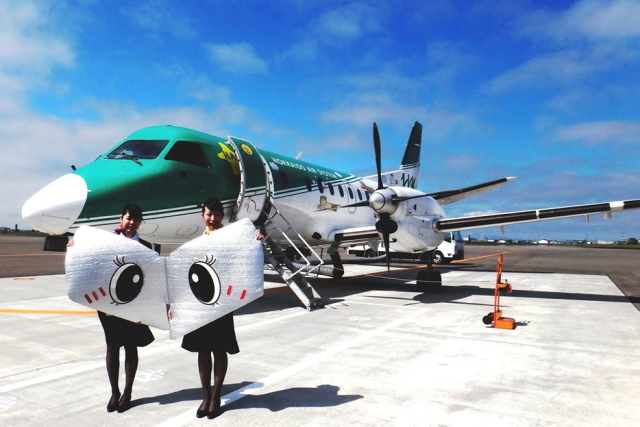
Boeing 737-81D(WL) JA801X departs Miyazaki on Solaseed Air's first ever international flight. It launched operations back in August 2002. (Photo: Aviation Wire)

The outbound leg departed Miyazaki at 0848 JST carrying 158 passengers, mostly local business officials, five flight attendants, and two pilots. Boeing 737-81D(WL) JA801X was assigned. For the first time, the local carrier of Kyushu served in-flight meals and alcoholic beverages on board.

Flight Schedule:
Miyazaki – Kaohsiung NEW charter with 737-800.
6J9167 KMI 0850 – 1020 KHH 73H Oct/17
6J9167 KMI 1155 – 1325 KHH 73H Oct/20
6J9168 KHH 1130 – 1440 KMI 73H Oct/17
6J9168 KHH 1435 – 1745 KMI 73H Oct/20

Miyazaki's local transportation company Miyakoh Group, which owns 24% of Solaseed, is responsible for marketing in Japan, while JPK International Air Service, based in Taipei, is carrying out sales in Taiwan. "We hope to make this a success and increase charters; we would like to learn what we could do and what our customers want us to do," said Hiroshi Takahashi, President of Solaseed (Solaseed Air eyes international charters in FY2015.).

The Kyushu-based carrier currently flies 68 daily domestic flights covering 10 routes and 10 destinations using a dozen 737-800s. Their entire domestic network code-shares and is closely coordinated with All Nippon Airways [NH/ANA] (Solaseed Air expands Okinawa with Ishigaki and Nagoya.), whose parent ANA Holdings controls roughly 9% of Solaseed, and virtually 35% when combined with the shares of Development Bank of Japan, a long-time ANA partner. Its official name will also be changed to Solaseed Air effective December 1st (Skynet Asia to officially change name to Solaseed Air.).

Source: Aviation Wire, 2015 October 17th. (in Japanese)
Source: Yomiuri Shimbun, 2015 October 18th. (in Japanese)

Sunday, October 18, 2015

ANA's Star Wars Boeing 787 flies first passenger flight.

On October 17th, All Nippon Airways [NH/ANA] operated a scenic charter flight using Boeing 787-9 JA873A R2-D2 ANA JET, which was unveiled on September 14th (ANA unveils Star Wars Boeing 787 R2-D2 ANA JET.) and had arrived at Tokyo/Haneda [HND/RJTT] on October 2nd after officially being handed over on September 29th. It became the first passenger-carrying flight for the first Star Wars-themed airplane.

Passengers on the scenic flight pose in front of Boeing 787-9 JA873A R2-D2 ANA JET after arriving back at Tokyo's Haneda Airport. Many participants wore costumes of popular characters from Star Wars. (Photo: Aviation Wire)

The sightseeing flight flying from and back to Haneda carried 170 passengers; 49 winners from a photo contest on ANA's website, 25 lucky groups of two who won the draw from 27,315 ANA Mileage Club (AMC) members' applications, and specially-invited guests along with media. R2-D2 ANA JET departed Haneda at 1327 JST and flew over Shizuoka, Nagoya, Miyatsu, Otsu, Hamamatsu, and Oshima, before returning to Tokyo's downtown airport at 1546.

Participants wearing costumes of characters from Star Wars. (Photo: Aviation Wire)

This marks the first time a character from the popular epic space opera appears on the exterior of a commercial aircraft, and the first of three special-themed aircraft featuring Star Wars to be painted by Japan's now largest airline (ANA reveals Star Wars Project.). The stretched Dreamliner is configured with 215 seats in a three-class configuration; 48 business, 21 premium economy, and 146 economy. Headrest covers along with paper napkins and cups also feature the iconic robot character in the series.

A participant dressed up as Darth Vader. (Photo: Aviation Wire)

Its first revenue flight is planned for October 18th as flight NH116 from Haneda to Vancouver [YVR/CYVR]. It will also be deployed to Beijing/Capital [PEK/ZBAA], Jakarta/Soekarno-Hatta [CGK/WIII], Munich [MUC/EDDM], Paris/Charles de Gaulle [CDG/LFPG], San Jose [SJC/KSJC], and Sydney/Kingsford Smith [SYD/YSSY] (ANA announces Haneda – Sydney.). Due to its popularity, ANA has decided to place the aircraft on limited domestic routes on a one-off basis; Haneda to Hakodate [HKD/RJCH] and Miyazaki [KMI/RJFM] on October 20th, to Hiroshima [HIJ/RJOA] and Matsuyama [MYJ/RJOM] on October 22nd, and to Kagoshima [KOJ/RJFK] and Osaka/Itami [ITM/RJOO] on October 31st.

Source: All Nippon Airways Japan @ Facebook.
Source: Aviation Wire, 2015 October 17th. (in Japanese)

Saturday, October 17, 2015

New AirAsia Japan receives first Airbus A320.

On October 16th, AirAsia Japan's (Mk II) [DJ] first aircraft, Airbus A320-216(SL) JA01DJ (MSN 6706), arrived at its hub at Nagoya/Chubu Centrair [NGO/RJGG]. Japan's newest airline had taken delivery of the airplane on October 9th. It departed Toulouse/Balgnac [TLS/LFBO] on October 14th and touched down at the main airport serving Nagoya at 1248 JST on October 16th, after making fuel stops at Cairo [CAI/HECA], Muscat [MCT/OOMS], and Yangon [RGN/VYYY]. As with other AirAsia-branded carriers' A320s, the airframe is configured with 180 seats.

Airbus A320-216(SL) JA01DJ receives a traditional water-cannon salute upon arriving at Nagoya' Chubu Centrair and passing by the prototype Boeing 787 Dreamliner donated to the airport. AirAsia Japan's (Mk II) second aircraft, which is planned for delivery in February 2016, will wear a special livery designed by photographer and film director Mika Ninagawa. (Photo: Aviation Wire)

The reincarnation of AirAsia's Japanese unit received its Air Operator's Certificate (AOC) on October 6th (New AirAsia Japan receives AOC; takeoff in April 2016.) and will launch operations in April 2016 initially serving three cities from Chubu Centrair; Sapporo/New Chitose [CTS/RJCC], Sendai [SDJ/RJSS] (New AirAsia Japan mulls Nagoya – Sendai.), and Taipei/Taoyuan [TPE/RCTP]. All will launch with double-daily frequencies, and details of the schedule will be released in late November when tickets will go on sale. Its fleet will start with two A320s, then quickly build up to six by year-end 2016, and see five additions each year after that to reach 11 by 2018, 16 by 2019, and at least 20 by 2020, when the Tokyo Olympics/Paralympics take place.

"Chubu's 24-hour operation is very attractive as it enables us to add red-eye or early morning flights, thus helping to increase aircraft utilization. The A320 can fly up to 4.5 hours, so all of Japan is covered and Korea, China, Taiwan, Guam, and Saipan are all within reach. Although we aren't in the position to disclose our fourth city, we will actively be adding new destinations in the first five years with a little more emphasis on international than domestic," said CEO Yoshinori Odagiri in a press conference at their RedBase headquarters following delivery, adding "Nagoya is one of Japan's three biggest metropolitan regions along with Tokyo and Osaka, and with Aichi being an industrial area, its population has been increasing. Until now, many have used airports in Tokyo or Osaka to travel beyond, but we would like to create more options from Chubu." The airline is aiming to produce its first full-year profit for FY2018.

Flight attendants of the new AirAsia Japan (Mk II) pose inside brand-new Airbus A320-216(SL) JA01DJ at Chubu Centrair. Crew training flights using the aircraft are expected to start as early as November. (Photo: Aviation Wire)

"We can be flying at least 120 flights in and out of Chubu by 2020," enthused Mr. Odagiri, adding "If we have 20 airplanes and each of them fly six flights (three round-trips) that adds up to 120. If we can have them fly eight legs, the figure would be greater." Aircraft-movement-wise, All Nippon Airways [NH/ANA] is currently the biggest carrier at Chubu Centrair with approximately 90 daily departures and arrivals, and AirAsia Japan's (Mk II) ambition exceeds that. Their next domestic city is expected to be Fukuoka [FUK/RJFF], with all near-term domestic additions to be in Hokkaido, Tohoku (Northeastern Japan), and Kyushu, where it would not need to compete with the super-efficient Shinkansen (Japanese bullet train). For international, coastal cities of China that are already served by AirAsia Group carriers are currently being closely looked at.

Chubu Centrair is planning to restart construction of a LCC terminal, with decision to be made by the end of the year. Mr. Odagiri said "We are currently talking with airport officials about how the terminal should look like including design and features. We hope they will go ahead with it, and we plan on moving there by 2018." The original plan was shelved when the first AirAsia Japan (Mk I) [JW/WAJ] halted operations in 2013, however, demand for a LCC-dedicated facility is increasing, with not only AirAsia Japan (Mk II) but also Chinese LCC Spring Airlines [9C/CQH] building a hub at Chubu Centrair. Other LCCs serving the airport include Cebu Air [5J/CEB] (d.b.a. Cebu Pacific), Hong Kong Express Airways [UO/HKE] (d.b.a. HK Express), Jeju Air [7C/JJA], and Jetstar Japan [GK/JJP], while V Air [ZV/ZAX] is starting in December.

In terms of voting rights, the new AirAsia Japan (Mk II) is owned by AirAsia Investment 33%, Rakuten 18%, Noevir Holdings 18%, Alpen 18%, and FinTech Global Trading 13%. It was founded in July 2014 (AirAsia Japan is officially reborn; first flight June 2015.) after the original AirAsia Japan (Mk I) (CoachFlyer JW8541: NRT - FUK on AirAsia Japan's Airbus A320.) stopped flying in October 2013 when the Malaysian parent terminated the joint-venture (JV) with partner ANA Holdings due to managerial differences. With the latter controlling 66%, everything needed to have consent from ANA, whose true interest was to tame AirAsia to protect the lucrative domestic market. That company now operates as Vanilla Air [JW/VNL] (Vanilla Air launches operations.) under 100% ANA control. This time around, AirAsia Japan (Mk II) will be making decisions on its own.

Source: Aviation Wire, 2015 October 16th. (in Japanese)
Source: Nikkei Shimbun, 2015 October 16th. (in Japanese)
Source: Aviation Wire, 2015 October 16th. (in Japanese)
Source: MyNavi, 2015 October 16th. (in Japanese)
Source: Nikkei Shimbun, 2015 October 17th. (in Japanese)
Source: Yomiuri Shimbun, 2015 October 17th. (in Japanese)

Wednesday, October 14, 2015

Jetstar Japan is coming to Taipei in November.

On October 13th, Jetstar Japan [GK/JJP] announced that they will start Tokyo/Narita [NRT/RJAA] – Taipei/Taoyuan [TPE/RCTP] on November 27th, followed by Osaka/Kansai [KIX/RJBB] – Taipei/Taoyuan on December 11th (Jetstar Japan launches Kansai hub.) and Nagoya/Chubu Centrair [NGO/RJGG] – Taipei/Taoyuan on December 12th. All three routes will initially operate three times weekly, increasing to daily by the end-of-the-year peak travel season. 180-seat Airbus A320s will be deployed.

Airbus A320-232 JA05JJ arrives at Matsuyama. Jetstar Japan's fleet remains capped at 20, excluding four aircraft sub-leased out to other carriers. (Photo: Ryosuke Yano)

The return legs for the Narita and Chubu Centrair links to Taiwan's capital are red-eye flights, while Narita and Kansai's outbound legs are timed late in the evening. Tickets went on sale at 1600 JST today, and promotional fares are offered for all three new routes starting from one-way 990 JPY, excluding tax and fuel surcharges.

Flight Schedule:
Tokyo/Narita – Taipei/Taoyuan NEW three weekly with A320-200 (daily from Dec/23).
GK11 NRT 2140 – 0040(+1) TPE 32A/320 Fr *From Nov/27.
GK11 NRT 2200 – 0100(+1) TPE 32A/320 We/Su *Nov/27 - Dec/9.
GK11 NRT 2200 – 0100(+1) TPE 32A/320 Mo/We/Su *Dec/11 - 21.
GK11 NRT 2200 – 0100(+1) TPE 32A/320 Mo/Tu/We/Th/Sa/Su *From Dec/23.
GK12 TPE 0330 – 0730 NRT 32A/320 Mo/Th/Sa *Nov/28 - Dec/10.
GK12 TPE 0330 – 0730 NRT 32A/320 Mo/Tu/Th/Sa *Dec/12 - 22.
GK12 TPE 0330 – 0730 NRT 32A/320 Daily *From Dec/24.

Osaka/Kansai – Taipei/Taoyuan NEW three weekly with A320-200 (daily from Dec/23).
GK51 KIX 2200 – 0010(+1) TPE 32A/320 We/Fr/Su *Dec/11 - 20.
GK51 KIX 2200 – 0010(+1) TPE 32A/320 Daily *From Dec/23.
GK50 TPE 1040 – 1405 KIX 32A/320 Mo/Th/Sa *Dec/12 - 21.
GK50 TPE 1040 – 1405 KIX 32A/320 Daily *From Dec/24.

Nagoya/Chubu Centrair – Taipei/Taoyuan NEW three weekly with A320-200 (daily from Dec/24).
GK91 NGO 0725 – 0950 TPE 32A/320 Mo/Th/Sa *Dec/12 - 21.
GK91 NGO 0725 – 0950 TPE 32A/320 Daily *From Dec/24.
GK92 TPE 0110 – 0445 NGO 32A/320 Mo/Th/Sa *Dec/12 - 21.
GK92 TPE 0110 – 0445 NGO 32A/320 Daily *From Dec/24.

Narita – Taipei/Taoyuan is high-demand but now sees heavy competition; full-service carriers Cathay Pacific Airways [CX/CPA], China Airlines [CI/CAL], Delta Air Lines [DL/DAL], EVA Airways [BR/EVA], Jetstar Japan's 33.3% owner Japan Airlines [JL/JAL], and TransAsia Airways [GE/TNA] along with fellow LCCs Scoot [TZ/SCO], Tigerair Taiwan [IT/TTW], and Vanilla Air [JW/VNL] all ply the route. Kansai – Taipei/Taoyuan already sees China Airlines, EVA, JAL, Jetstar Asia Airways [3K/JSA], Peach Aviation [MM/APJ], Tigerair Taiwan, and TransAsia Airways operating, while Chubu Centrair – Taipei/Taoyuan has China Airlines and JAL only, though V Air [ZV/VAX] is preparing to enter in December and new AirAsia Japan [DJ] in April 2016 (New AirAsia Japan receives AOC; takeoff in April 2016.).

Taipei only becomes Jetstar Japan's second international destination after Hong Kong; service from Kansai was launched in February (Jetstar Japan goes international with Kansai – Hong Kong.) followed by Narita in June (Jetstar Japan starts Narita – Hong Kong.). On October 2nd, the Narita-based LCC together with Jetstar Airways [JQ/JST] and Jetstar Asia received regulatory approval from Japan's Ministry of Land, Infrastructure, Transport, and Tourism (MLIT) to coordinate flight times and prices on international routes between Japan and Taiwan and the Philippines. Manila could become Jetstar Japan's third international city.

Source: Jetstar Japan, 2015 October 2nd. (in Japanese)
Source: Jetstar Japan, 2015 October 13th. (in Japanese)

Tuesday, October 13, 2015

Hokkaido Air System loads Yuzhno-Sakhalinsk charter.

Hokkaido Air System [HC/NTH] announced that they will operate a charter flight between Sapporo/Okadama [OKD/RJCO] and Yuzhno-Sakhalinsk [UUS/UUHS] on the Russian-controlled island of Sakhalin, or Karafuto in Japanese, later this month using its 36-seat Saab SF340B. It will be operated on behalf of the Sakhalin-Hokkaido Economy Mission, a group of local business executives and Hokkaido government officials, including Governor Harumi Takahashi, visiting Sakhalin to strengthen economic ties.

Saab SF340B-WT JA01HC rests between flights at Sapporo's Okadama Airport. It continues to fly in this unique livery, though officially it was scrapped by HAC and replaced by JAL's conventional crane logo effective July 16th to reflect the change in ownership. (Photo: Hokkaido Air System)

Mrs. Takahashi will meet Governor of Sakhalin Oleg Kojemiako to discuss how to promote economic relations and participate in the opening of Hokkaido Center, built by Japanese-Russian joint-venture Hokkaido Developers Group, or HODEG. It will house the Hokkaido branch for Sakhalin.

Flight Schedule:
Okadama – Yuzhno-Sakhalinsk charter with SF340B. 
HC901 OKD 0900 – 1115 UUS SF3 *Oct/22 only charter.
HC102 UUS 1230 – 1245 OKD SF3 *Oct/22 only ferry flight.
HC103 OKD 1400 – 1615 UUS SF3 *Oct/24 only ferry flight.
HC904 UUS 1715 – 1730 OKD SF3 *Oct/24 only charter.

Hokkaido Air System, unofficially but commonly referred to as HAC, became a Japan Airlines [JL/JAL] subsidiary once again after the nation's second largest carrier increased its stake in Hokkaido's commuter airline to 51.23% effective October 23rd, 2014 (JAL raises Hokkaido Air System stake to 51%.). It was originally founded jointly by Japan Air System [JD/JAS] and the Hokkaido Government back in September 1997 to provide high-speed public transportation between the island's major cities as well as the small remote islands.
 
From its hub at Okadama, the smaller but more convenient airport near downtown, HAC currently operates to Hakodate [HKD/RJCH], Kushiro [KUH/RJCK], Misawa [MSJ/RJSM] (CoachFlyer HC330: MSJ - OKD on Hokkaido Air System's Saab SF340.), and Rishiri [RIS/RJER], plus a link to Okushiri [OIR/RJEO] from Hakodate, using a fleet of three SF340Bs. JAL is currently considering using HAC to resume three intra-Hokkaido routes; Hakodate – Kushiro, Hakodate – Asahikawa [AKJ/RJEC], and Okadama – Memanbetsu [MMB/RJCM] (Hokkaido Air System to resume three intra-island routes.).

Source: Hokkaido Government, 2015 October 2nd. (in Japanese)
Source: Hokkaido Air System, 2015 October 2nd. (in Japanese)

Tuesday, October 6, 2015

New AirAsia Japan receives AOC; takeoff in April 2016.

On October 6th, AirAsia Japan (Mk II) [DJ] was officially granted an Air Operator's Certificate (AOC) from Japan's Ministry of Land, Infrastructure, Transport, and Tourism (MLIT). It had filed an application on July 21st (AirAsia Japan confirms Spring 2016 launch from Nagoya.). Japan's newest LCC will launch operations in early April 2016 from its Nagoya/Chubu Centrair [NGO/RJGG] hub (AirAsia Japan selects Nagoya Chubu Centrair.) to Sapporo/New Chitose [CTS/RJCC], Sendai [SDJ/RJSS] (New AirAsia Japan mulls Nagoya – Sendai.), and Taipei/Taoyuan [TPE/RCTP] using an initial fleet of two 180-seat Airbus A320s. Its two-letter IATA code will be DJ.

The new AirAsia Japan's (Mk II) first aircraft Airbus A320-216(SL) JA01DJ/F-WWBV at Hamburg/Finkenwerder. It will be delivered shortly and is planned to arrive at Nagoya's Chubu Centrair on October 16th. (Photo: Tobias Gudat)

All three routes will start off with two daily round-trips, and details of their flight schedule will be released in late November, which will coincide with ticket sales start. The Japanese unit of Asia's largest LCC group aims to offer fares at approximately half or third of the price of full-service carriers such as All Nippon Airways [NH/ANA] and Japan Airlines [JL/JAL]. AirAsia Japan's (Mk II) initial expansion will focus on international destinations already served by an AirAsia Group carrier and within a four-hour radius from Chubu Centrair, with domestic routes following afterwards. It sees itself eventually flying 55% international and 45% domestic.

"We're targeting both inbound and domestic visitors. The Chubu (Greater Nagoya) region also has a population of 15 million, so there should be much more demand," said Yoshinori Odagiri, CEO of AirAsia Japan (Mk II), adding "For Sendai, those from abroad want to see Sakura in the spring and snow in the winter, and it's becoming popular among the Japanese too. If we can create demand and increase to four or five flights a day, it may become more appealing to business travelers as well." Sendai will be an all-new city on AirAsia Group's network; New Chitose is served by AirAsia X [D7/XAX] and Taipei/Taoyuan by both AirAsia [AK/AXM] and the AirAsia X.

AirAsia Japan (Mk II) has built Red Base, its headquarters and the base for other AirAsia Group activities in Japan, on the grounds of Nagoya Chubu Centrair. A 180-room low-cost hotel is also being erected at the airport by affiliate Red Planet Japan on behalf of Tune Hotels. (Photo: Aviation Wire)

"We are very excited to be back in Japan. We have fantastic partners here and we are united in the vision to change the way people travel in Japan," commented AirAsia Group CEO Tan Sri Tony Fernandes, going on to say "Centrair is a fantastic base and with our new routes, we look forward not only to enable the Japanese to enjoy our direct destinations but to connect them to the rest of Asia and beyond on our extensive network." The group's Malaysian long-haul arm is looking at resuming service to Chubu Centrair, along with Thai AirAsia X [XJ/TAX] as well, when ICAO's red flag on Thailand is lifted, to feed the Japanese unit's network.

Its first aircraft, A320-216(SL) JA01DJ, will arrive at Chubu Centrair on October 16th, having completed its first flight on July 7th and currently awaiting delivery at Toulouse/Blagnac [TLS/LFBO]. AirAsia Japan's (Mk II) A320s will be supplied from the huge AirAsia Group order pool, and they plan on building its fleet to six by the end of 2016. Five aircraft will be added each year onwards; 11 aircraft by the end of 2017 and 16 by the end of 2018. If demand warrants, they have the option to add two additional A320s by the end of 2018. Its headquarters were officially moved to its brand-new Red Base at Chubu Centrair effective September 29th, and the first batch of crews have already started training in Malaysia. The current workforce of 100 will be increased to around 250 by April 2016.

AirAsia Japan (Mk II) (AirAsia Japan is officially reborn; first flight June 2015.) also completed a shareholding structure reorganization on September 25th. Voting-rights-wise, AirAsia Investment's 33% and Rakuten's 18% ownership haven't changed, while Noevir Holdings' shareholding has been increased from 13.4% to 18% and Alpen from 7.4% to 18%, with FinTech Global Trading, a new investor, now holding 13%. Meanwhile, Octave Japan Infrastructure Fund no longer holds any voting stocks, though it will retain non-voting shares. This is AirAsia Group's second crack into the Japanese market; the original AirAsia Japan (Mk I) [JW/WAJ] (CoachFlyer JW8541: NRT - FUK on AirAsia Japan's Airbus A320.) ended in a divorce with joint-venture (JV) partner ANA Holdings due to managerial differences only 10 months after launching operations. That company now operates as Vanilla Air [JW/VNL] (Vanilla Air launches operations.) under 100% ANA control.

Source: The Star (Malaysia), 2015 October 6th. (in Japanese)
Source: Aviation Wire, 2015 October 6th. (in Japanese)

Monday, October 5, 2015

Ryukyu Air Commuter launches Q400 Cargo-Combi.

On September 30th, Ryukyu Air Commuter [RAC] disclosed that it will acquire five of the Bombardier DHC-8-400Q Dash 8 Cargo-Combi, becoming one of the new variant's launch customers. The contract was unidentified at the time of order at the Farnborough Air Show in July 2014. All five airframes will be delivered in combi configuration seating 50 passengers, with the first aircraft expected to arrive in December 2015, followed by crew training before entering service in April 2016.

A rendering of RAC's Bombardier DHC-8-400Q Dash 8 Cargo-Combi. (Image: Bombardier)

RAC currently operates a single 50-seat DHC-8-300Q alongside four 39-seat DHC-8-100Qs, and the new Q400s will replace these aircraft on a one-to-one basis. All five machines will be delivered by the end of FY2017. Based on list prices, the order is valued at approximately 168 million USD. "RAC shares a long history with Bombardier, collaborating together since 1997 when we first introduced Japan to the Dash 8 Series 100 aircraft. Since then, the Dash 8 has become the backbone of our efficient and productive operation," said Takashi Irei, RAC's President.

"Today we celebrate another first as we confirm that the Q400 Cargo-Combi aircraft is the ideal platform for our future fleet as we endeavor to offer comfort, reliability, and improved air transportation capabilities to our passengers, while supporting our local economies and communities with our extra cargo capability. Equipped with a new fleet, RAC looks forward to carrying many additional passengers as they enjoy travelling around Japan’s Okinawa islands,” Mr. Irei continued. RAC's Q400 Cargo-Combi will boast 23.4 cubic meters of cargo space, compared to 9.1 for the Q300 and 8.5 for the Q100.

Based at Okinawa/Naha [OKA/ROAH], RAC is a regional commuter airline connecting the remote islands in the Ryukyu Archipelago in southern Japan. It is 72.9% owned by JAL Group's Okinawan affiliate Japan Transocean Air [NU/JTA], 5.1% by the Government of Okinawa, and the remainder by local businesses.

Source: Bombardier, 2015 September 30th. (in English)
Source: Traicy, 2015 September 30th. (in Japanese)
Source: Aviation Wire, 2015 September 30th. (in Japanese)

Wednesday, September 30, 2015

Skymark relaunched with ANA sponsorship.

On September 29th, bankrupt Skymark Airlines [BC/SKY] (Skymark to file for bankruptcy.) officially revamped its ownership structure and management. A 100% capital reduction was performed, followed by a 18 billion JPY capital injection together from Integral Corporation, ANA Holdings, and UDS Airlines Investment, which officially became the new owners of the embattled airline, controlling 50.1%, 16.5%, and 33.4%, respectively (Creditors choose ANA/Skymark proposal over Delta/Intrepid.). UDS is a new investment firm jointly owned by Development Bank of Japan (DBJ) and Sumitomo Mitsui Banking, both now long-time partners of ANA Holdings.

Boeing 737-86N(WL) JA73NJ taxies at New Chitose. Skymark intends to retain a fleet of at least 26 baby Boeings. Can Skymark remain independent? Caught in between the incumbent carriers and new LCCs, what market could it pursue outside its bread-and-butter (for now) Haneda? (Photo: Ryosuke Yano)

The former Skymark management, including Chairman Takashi Ide and President Masakazu Arimori, has been entirely replaced by six new executives. Integral's President Nobuo Sayama has become Chairman and Masahiko Ichie of Development Bank of Japan (DBJ) assumed the role of President. Senior Managing Director is Hideo Yaguchi from OCS, an ANA Holdings cargo subsidiary, who will be responsible for general supervision. Manabu Motohashi, the sole person on the board from within Skymark, is Managing Director and Executive Officer, taking responsibility for management planning, overall control for marketing, and information system. Integral's Shigeki Nishioka has become Director and Executive Officer, overseeing finance, accounting, general affairs, human resources, and listing preparation. ANA's Noriyuki Masukawa has been appointed Director to supervise safety operations.
 
At the same time, Skymark signed a binding code-sharing agreement with rival All Nippon Airways [NH/ANA], subsidiary of the bankrupt carrier's now 16.5% owner ANA Holdings, which is the centerpiece of the struggling airline's corporate rehabilitation plan (Skymark gives in to ANA; Japan reverts to duopoly.). Discussions are being held to implement code-sharing on 13 routes; all but three routes out of Tokyo/Haneda [HND/RJTT] and Sendai [SDJ/RJSS], which is being axed at the end of next month (Skymark to pull out of Sendai in October.). Omitted from Haneda are to Fukuoka [FUK/RJFF], Kagoshima [KOJ/RJFK], and Sapporo/New Chitose [CTS/RJCC], where ANA already commands the lion's share of flights and they learned the Japan Fair Trade Commission is unlikely to give a nod.

"We're working towards starting code-sharing in Winter 2016/2017," said Mr. Sayama, adding "We hope to reveal the outline of code-sharing by mid-October." ANA has been pushing Skymark to adopt their Able-D reservations system, which was also taken up by previous ANA-sponsored airlines AIRDO [HD/ADO] (d.b.a Air Do), Skynet Asia Airways [6J/SNJ] (d.b.a. Solaseed Air), and Star Flyer [7G/SFJ]. However, taking up the system meant pricing needed to have consent from ANA, and all income would go into ANA first and then later be transferred to the airlines, virtually making the three quasi-subsidiaries of ANA. Mr. Sayama has said "Nobody can call that independent, so Skymark can't do that." Outgoing Chairman Mr. Ide had also stated that preserving Skymark's own reservations system, handmade by former President and CEO Shinichi Nishikubo, and modifying it to make it compatible with code-shares, instead of abandoning it and wholly-adopting Able-D, is key to keeping Skymark independent from ANA.

Boeing 737-881(WL) JA75AN takes off from Haneda. Now the ANA group has direct and indirect influence over a dominant 60% of domestic slots at Haneda. With Air Do, Solaseed Air, and Star Flyer having adopted ANA's reservations system and effectively becoming de facto subsidiaries of ANA, a key to Skymark's independence in the long term is to continue using its own platform. (Photo: Ryosuke Yano)

In addition, Skymark reached an agreement with Mizuho Bank for the establishment of a commitment line on September 17th, allowing up to 10 billion JPY in financing. Payments to creditors will commence on November 30th, and those claiming 1 million JPY will receive the entire figure while those claiming more will initially be given 5% of the amount exceeding 1 million JPY. Biggest creditor Intrepid Aviation, which initially sought for 900 million USD (108 billion JPY) for scrapping Airbus 330 leases (Skymark terminates all Airbus A330 leases.) and fought against ANA to sponsor Skymark with Delta Air Lines [DL/DAL] (Intrepid picks Delta to sponsor Skymark.), has compromised at 57.3 billion JPY, while talks are still continuing with Airbus, Rolls-Royce, and CIT Aerospace, which are the second, third, and fourth largest creditors, respectively. A settlement with Airbus and Rolls-Royce is to be watched, as rumors point out to ANA making a backroom deal to purchase three of Skymark's canceled Rolls-Royce-powered A380s and taking options for two more, which prompted the two creditors to make a last-minute sway in favor of ANA's sponsorship over Delta's (Bye-bye Skymark, Hello ANA Airbus A380?).

Mr. Ichie said that no new routes nor route cuts are planned for the following year, after Sendai is axed. The new chief said Skymark will focus more on building loyalty in its communities where it has a relatively stronger brand recognition, such as in Kobe [UKB/RJBE] and Ibaraki [IBR/RJAH]. The fleet will be kept at at least 26 Boeing 737-800s, and whether to renew the lease of the 27th machine, which is expiring in January 2016, is currently being evaluated. Mr. Sayama confirmed that Skymark will retain its current identity even after it emerges from bankruptcy protection, instead of renaming it SKY bee (Skymark hints at new brand: SKY bee?). Both the new and old management agree that Skymark could become quickly profitable and be listed again in three years. Regulator Japan Civil Aviation Bureau (JCAB) has hinted limiting ANA's financial involvement in Skymark to five years to keep competition at Haneda, however, ANA's cozy relationship with the governing Liberal Democratic Party (LDP) could make the winds blow in their favor again.

Skymark's load factors are quickly recovering. Although August is normally a high month as it is the peak summer vacation travel season coupled with Obon homecoming, the bankrupt airline produced load factors exceeding 90% for most Haneda routes. It doesn't directly translate to yields, however, it is nevertheless a positive sign. With the Ministry of Land, Infrastructure, Transport, and Tourism (MLIT) currently planning to allocate most, if not all of, new future slots at Haneda to international flights in preparation for the 2020 Tokyo Olympics/Paralympics, its domestic market remains closed off to LCCs, making Skymark the only low-fare option at Japan's most important airport. But what market will Skymark pursue beyond that? It has lost against LCCs on almost every other directly-competing route, and though much lower cost and offering lower fares than ANA or JAL, it has failed to generate demand, which the LCCs have succeeded in doing. Regional international routes within reach of its 737s are also seeing growing competition from LCCs. And with the domestic market shrinking, Haneda is not a safe haven forever.

Finding itself being caught in between the majors and LCCs forced Skymark to boldly (and unsuccessfully) pursue the demand for affordable premium travel, initially in the domestic market with all-premium A330s (Skymark Airlines inaugurates Airbus A330 service.) and in the international long-haul arena with premium-only A380s (Skymark posts loss but optimistic with strategy tweaks.). The A330s were also equipped with full galleys so that it could fly regional international routes as well. However, it was too costly and Skymark failed there. So what future lies for Skymark in the long term?

Source: Aviation Wire, 2015 September 1st. (in Japanese)
Source: Aviation Wire, 2015 September 2nd. (in Japanese) 
Source: Aviation Wire, 2015 September 11th. (in Japanese)
Source: Hokkaido Shimbun, 2015 September 15th. (in Japanese)
Source: Toyo Keizai, 2015 September 17th. (in Japanese)
Source: Toyo Keizai, 2015 September 24th. (in Japanese)
Source: Aviation Wire, 2015 September 29th. (in Japanese)
Source: Skymark Airlines, 2015 September 29th. (in English)
Source: Nikkei Shimbun, 2015 September 29th. (in Japanese)
Source: Aviation Wire, 2015 September 29th. (in Japanese)

Monday, September 14, 2015

ANA unveils Star Wars Boeing 787 R2-D2 ANA JET.

On September 12th, All Nippon Airways [NH/ANA] rolled out Boeing 787-9 JA873A R2-D2 ANA JET (ANA reveals Star Wars Project.), the first of three special-themed aircraft featuring Star Wars, at Paine Field [PAE/KPAE]. This marks the first time a character from the popular epic space opera appears on the exterior of a commercial aircraft. It took 10 days to paint R2-D2 on ANA's newest Dreamliner, which will be configured with 215 seats (48 business, 21 premium economy, and 146 economy).

Boeing 787-9 JA873A R2-D2 ANA JET was rolled out from Boeing's factory in Everett on September 12th at 0900 PST. (Photo: ANA)

After cabin work is finished, R2-D2 ANA JET will be delivered at the end of September and is expected to arrive in Japan in early October. Service entry is scheduled for October 18th as flight NH116 from Tokyo/Haneda [HND/RJTT] to Vancouver [YVR/CYVR]. It will also be deployed to Beijing/Capital [PEK/ZBAA], Jakarta/Soekarno-Hatta [CGK/WIII], Munich [MUC/EDDM], Paris/Charles de Gaulle [CDG/LFPG], San Jose [SJC/KSJC], and Sydney/Kingsford Smith [SYD/YSSY] (ANA announces Haneda – Sydney.) later on.

JA873A will be adorned with the iconic robot until March 2020. (Photo: ANA)

One day prior to inaugurating service, R2-D2 ANA JET will be assigned to a scenic flight from Haneda. 39 winners from a photo contest on ANA's website that will end on September 18th will be invited, and all members of ANA Mileage Club (AMC) are also eligible to apply for a scarce 25 groups of two made available. The five-year Star Wars Project agreement with The Walt Disney Company (Japan) will take advantage of the release of The Force Awakens, the series' latest episode and the first of the next trilogy, to bolster ANA's brand-awareness in the international arena.

Due to overwhelming popularity, last month ANA decided to paint two more aircraft in the Star Wars theme (ANA announces Boeing 777 and 767 Star Wars Jets.). 777-381/ER JA789A will be adorned with BB-8 and be named BB-8 ANA JET to ply intercontinental routes alongside R2-D2 ANA JET, while 767-381/ER JA604A will be painted as STAR WARS ANA JET and fly domestic routes. The former will enter service in March 2016 and the latter in November this year. The three special livery aircraft will fly until March 2020, when the five-year contract expires.

Source: All Nippon Airways Japan @ Facebook.
Source: Aviation Wire, 2015 September 13th. (in Japanese)

Saturday, September 5, 2015

Peach Aviation starts Okinawa – Seoul.

On September 4th, Peach Aviation [MM/APJ] launched Okinawa/Naha [OKA/ROAH] – Seoul/Incheon [ICN/RKSI] (Peach announces Okinawa – Seoul.). Operated by 180-seat Airbus A320-200s, the daily service became their fifth route out of their Naha hub (Peach launches Naha hub; but Naha – Ishigaki axed.). Japan's so far most successful LCC already serves the South Korean capital three times daily from Osaka/Kansai [KIX/RJBB].

Airbus A320-214 JA808P departs on Peach's inaugural flight from Naha to Incheon. It boasts a modest fleet of 16 A320s. Their 17th will arrive in November, followed by one aircraft each in March, July, and November next year for a total of 20. (Photo: Aviation Wire)

Inaugural flight MM905 departed Naha at 1304 JST with 151 passengers, including five children. Along with locals, many American workers at Okinawa's U.S. bases were also on the flight. Aircraft assigned was A320-214 JA808P, which arrived at Incheon 17 minutes late at 1532 due to traffic congestion. Return leg MM906 left Incheon at 1611 carrying a full load of 180 passengers, including three children, and arrived at Naha at 1824.

"Unlike the majors, Peach's target is younger travelers. We're seeing repeaters," said Shinichi Inoue, CEO of the Kansai-headquartered LCC, when asked about expansion in the Japan – South Korea market, which has seen Japanese incumbents reducing capacity due to political tensions and territorial disputes. Tokyo/Narita [NRT/RJAA]-based sister LCC Vanilla Air [JW/VNL] also withdrew from the market in March this year (Vanilla Air to suspend Seoul.).

Flight Schedule:
Naha – Seoul/Incheon NEW daily with A320-200.
MM905 OKA 1305 – 1515 ICN 320 Daily
MM906 ICN 1555 – 1805 OKA 320 Daily

Peach first arrived in Naha with service from Kansai on October 18th, 2012, and added Ishigaki [ISG/ROIG] on September 13th, 2013, followed by Taipei/Taoyuan [TPE/RCTP] seven days later. It was upgraded to a hub on July 19th, 2014 with the launch of Fukuoka [FUK/RJFF], though Ishigaki became the first route to be axed on Peach's network at the same time (Peach launches Naha hub; but Naha – Ishigaki axed.). Although Mr. Inoue cited heavy competition as the reason for the suspension, rumors point out to 39% owner ANA Holdings pressuring Peach to exit the short but high-demand route connecting the two major Okinawa islands to protect All Nippon Airways [NH/ANA]. Hong Kong [HKG/VHHH] was launched on February 21st (Peach commences Okinawa – Hong Kong.).

The growing LCC currently bases two A320s at Naha, with ambitions to turn it into a scissors hub to funnel passengers between the main islands of Japan and Southeast Asia. Peach has publicly said Thailand and Vietnam are their top priorities, followed by Malaysia and Singapore. Bangkok/Don Mueang [DMK/VTBD] is being evaluated for launch during the Winter 2015/2016 timetable (Peach mulls Okinawa – Bangkok.), possibly sometime after their 17th A320 is delivered in November. However, Peach does not offer a fly-through product as of yet, forcing passengers to buy two segments separately if they wished to connect, and this may need to change if Mr. Inoue is serious about a full-fledged transit hub.

Source: Aviation Wire, 2015 September 4th. (in Japanese)

Wednesday, September 2, 2015

ANA restores Kuala Lumpur link.

On September 1st, All Nippon Airways [NH/ANA] resumed Kuala Lumpur/Sepang [KUL/WMKK] with daily nonstop service from Tokyo/Narita [NRT/RJAA] using 240-seat (42 business and 198 economy class) Boeing 787-8s, ending a 13-year hiatus (ANA reveals Kuala Lumpur and expansion at Narita.). ANA used to serve the city via Bangkok/Don Mueang [DMK/VTBD] until January 14th, 2002.

Boeing 787-8 JA829A prepares for departure from Narita for their first flight to Kuala Lumpur on September 1st. ANA's Dreamliner fleet is comprised of 34 -8s and seven -9s, with another two and 36 on order, respectively, along with three -10s. (Photo: Aviation Wire)

Inaugural flight NH815 departed Narita on-time at 1720 JST with a load of 227 passengers. It took off 18 minutes later. "We have been strengthening our Asian network, and Kuala Lumpur had been at the top of our wishlist," said Osamu Shinobe, President of ANA, adding "We expect Asia – North America travel to account for 40%. With Narita's departure and arrival timed for connections, Star Alliance's unfinished business here is how to connect at the Malaysia end."

Flight Schedule:
Narita – Kuala Lumpur/Sepang NEW 1 daily with 787-8.
NH815 NRT 1720 – 2335 KUL 788 Daily
NH816 KUL 0700 – 1500 NRT 788 Daily 

The new round-trip is timed to receive feed from North American arrivals at Narita, while the departure from Kuala Lumpur is timed for onward connections across the Pacific after arriving into Narita.

The route sees competition from Japan Airlines [JL/JAL] with a daily flight operated by 767-300ERs and Malaysia Airlines [MH/MAS] with 10 times weekly flown with Airbus A330-300s. AirAsia X [D7/XAX] suspended its Narita link effective August 20th, though it continues to operate daily from Tokyo/Haneda [HND/RJTT], the preferred downtown airport serving Japan's capital.

Source: Aviation Wire, 2015 September 1st. (in Japanese)

Tuesday, September 1, 2015

JAL shifts more Tokyo – China flights from Narita to Haneda.

On August 31st, Japan Airlines [JL/JAL] announced plans to expand their China network from Tokyo/Haneda [HND/RJTT] with new daily service to Guangzhou [CAN/ZGGG] and Shanghai/Pudong [PVG/ZSPD] along with a second daily round-trip to Beijing/Capital [PEK/ZBAA] effective October 25th, the beginning of the Winter 2015/2016 timetable. Meanwhile, Tokyo/Narita [NRT/RJAA] will see JAL axe Guangzhou and reduce Beijing from twice to once daily.

Nine 767s, including pictured Boeing 767-346/ER(WL) JA618J at Honolulu, are equipped with winglets and Sky Suite interior. JAL, which flies 32 -300ERs and 12 -300s, is celebrating their 30th year of 767 operations. 60 were ordered and the first, a -200, was delivered back on July 23rd, 1985. Although 787s are gradually taking over the 767s' roles, newer -300ERs are being converted to domestic, replacing older -300s and 777s. The versatile aircraft will surely soldier on for another decade or two. (Photo: Ryosuke Yano)

The new Haneda – Shanghai/Pudong link will be served by Boeing 767-300ERs configured with JAL's award-winning Sky Suite product (JAL adding more Sky Suite destinations.) and boasting a generous 199-seat layout (24 business and 175 economy class). The new Guangzhou and additional Beijing flights will see non-Sky Suite 227-seat (30 business and 197 economy class) 767-300ERs deployed.

Flight Schedule:
Haneda – Tokyo/Haneda – Beijing/Capital increase from 1 to 2 daily.
JL021 HND 0910 – 1220 PEK 788 Daily
JL025 HND 1720 – 2030 PEK 763 Daily *NEW from Oct/25.
JL020 PEK 0825 – 1245 HND 763 Daily *NEW from Oct/26.
JL022 PEK 1640 – 2100 HND 788 Daily

Tokyo/Haneda – Guangzhou NEW daily with 767-300ER.
JL087 HND 0850 – 1305 CAN 763 Daily *From Oct/25.
JL088 CAN 1450 – 1945 HND 763 Daily *From Oct/25.

Tokyo/Haneda – Shanghai/Hongqiao daily with 777-200ER. (existing service)
JL081 HND 0915 – 1145 SHA 772 Daily
JL082 SHA 1305 – 1645 HND 772 Daily

Tokyo/Haneda – Shanghai/Pudong NEW daily with 767-300ER.
JL085 HND 1440 – 1710 PVG 76W Daily *From Oct/25.
JL086 PVG 1835 – 2220 HND 76W Daily *From Oct/25.

In May, authorities of China and Japan agreed to allocate two round-trips to each side for Haneda – Guangzhou services. JAL's archrival All Nippon Airways [NH/ANA] was the first to take advantage, having already announced a similar expansion at Haneda and shift away from Narita (ANA strengthens Haneda – China with Guangzhou.). China Southern Airlines [CZ/CSN], based in China's third most populated city, is reportedly also preparing to launch the route though no official announcement has yet been made.

Source: Japan Airlines, 2015 August 31st. (in Japanese) 
Source: Aviation Wire, 2015 September 1st. (in Japanese)