Sunday, February 22, 2015

Peach commences Okinawa – Hong Kong.

On February 21st, Peach Aviation [MM/APJ] launched four-times-weekly Okinawa/Naha [OKA/ROAH] – Hong Kong [HKG/VHHH] service with 180-seat Airbus A320s, as announced in September last year (Peach announces Okinawa – Hong Kong.). The new link becomes the Osaka/Kansai [KIX/RJBB]-headquartered LCC's seventh international route overall, and its fourth nonstop destination from its second hub at Naha (Peach launches Naha hub; but Naha – Ishigaki axed.).

Peach's Naha staff see off Airbus A320-214 JA803P depart on their inaugural flight to Hong Kong on February 21st. The launch of their long-awaited first route to Southeast Asia from the Ryukyu airport this summer will likely coincide with their 15th A320 delivery in July. (Photo: Aviation Wire)

The last time the route saw a Japanese carrier operating was until March 2003 with Japan Airlines [JL/JAL]; Peach thus becomes the first LCC to fly the route and the first Japanese airline in 12 years.

The inaugural outbound flight MM965 departed Naha at 1522 JST with a load of 127 passengers, including three children. A320-214 JA803P was assigned to the flight. Meanwhile, the first inbound flight MM964 touched down at Naha at 1605 JST with 168 passengers on board. It was operated by A320-214 JA801P. Victor L. L. Chu, Chairman of Hong Kong-based Far Eastern Investment Group, which owns 33.3% of Peach, was also on the inaugural inbound leg.

Flight Schedule (Feb/21 - Mar/28)
Naha – Hong Kong NEW 4 weekly with A320-200.
MM965 OKA 1645 – 1830 HKG 320 Mo
MM965 OKA 1530 – 1715 HKG 320 We
MM965 OKA 1525 – 1710 HKG 320 Sa
MM965 OKA 1305 – 1450 HKG 320 Su
MM964 HKG 1235 – 1550 OKA 320 Mo/We/Sa/Su

Flight Schedule (Mar/29 - Oct/24)
Naha – Hong Kong 3 weekly with A320-200.
MM965 OKA 1340 – 1505 HKG 320 Mo/Fr/Sa
MM964 HKG 1230 – 1600 OKA 320 Mo/Fr/Sa

One-way fares start from 7,180 JPY. Peach has initially decided to serve the route four times a week, but will reduce to three times during the upcoming Summer 2015 timetable. CEO Shinichi Inoue says he wants to fly the route daily, as soon as favorable slot times become available at the bustling airport serving the former British colony. "Inbound demand has been extraordinary, and I'm convinced that Okinawa is already a very attractive destination," Mr. Inoue commented, adding "We wanted to launch the route in time for the Chinese New Year peak travel period."

Meanwhile, Mr. Inoue also confirmed that their first destination in Southeast Asia will be served from Naha this summer, and the city will be revealed in March. "From Naha, we eventually want to fly to Ho Chi Minh City, Hanoi, Bangkok, Kuala Lumpur, and Singapore," said Mr. Inoue. Earlier in February, Airports of Thailand (AoT), which manages the kingdom's six major international airports, disclosed that Peach is discussing Naha – Bangkok/Don Mueang [DMK/VTBD] (Peach mulls Okinawa – Bangkok.). With Thailand now being Japan's sixth biggest inbound market accounting for 4.9% of all foreign visitors, and Japan the most popular outbound market for Thailand, this route is highly likely to become Peach's first link to Southeast Asia.

The Naha hub was launched in July 2014 with ambitions to use it as a scissors hub to funnel passengers between the main islands of Japan and Southeast Asia. From their Okinawa hub, the growing LCC serves Fukuoka [FUK/RJFF], Kansai, Taipei/Taoyuan [TPE/RCTP], and now Hong Kong. Naha – Ishigaki, which was axed in July 2014 owing to heavy competition (Peach launches Naha hub; but Naha – Ishigaki axed.), could be resumed when the airline has "enough resources to fly two or three daily flights," Mr. Inoue said. Miyako [MMY/ROMY] is also on Peach's radar. Meanwhile, a third hub is being set up at Tokyo/Narita [NRT/RJAA] (Peach confirms Narita hub; adds Fukuoka and Sapporo.).

Source: Ryukyu Shimpo, February 21st. (in Japanese)
Source: Aviation Wire, February 21st. (in Japanese)

Wednesday, February 18, 2015

Skymark likely to accept ANA sponsorship.

Skymark Airlines [BC/SKY] is bankrupt (Skymark to file for bankruptcy.). But the biggest question does not change: who will come to save them? ANA Holdings, parent of Japan's largest carrier All Nippon Airways [NH/ANA], financial services group Orix, travel agency H.I.S., Shinsei Bank, and major trading firm Sojitz seem to be some of the high-profile names that have shown interest so far. At the center of the picture is the cash-strapped airline's 36 slot-pairs at Tokyo/Haneda [HND/RJTT], the preferred but heavily-regulated downtown airport serving the capital.

ANA, JAL, and Skymark aircraft at Haneda. The flagship all-premium A330s were grounded only three days after announcing its bankruptcy filing. An ANA/Skymark tie-up is appearing likely, which is the last thing JAL wants to see. (Photo: Aviation Wire)

Last spring, a few months before Skymark's Airbus A380 issue (Skymark's Airbus A380 order in jeopardy.) came into light, Japan Civil Aviation Bureau (JCAB) was already aware of the troubled airline's deteriorating financial health and had approached Delta Air Lines [DL/DAL] to assist. ANA and Japan Airlines [JL/JAL] furiously lobbied the government not to allow an airline holding Haneda's domestic slots to slip into foreign hands. 

When JAL filed for bankruptcy in 2010, JCAB succeeded in bringing Delta to the table to discuss a plan to save JAL together with Japanese investment firms. JAL eventually chose government bailout and remained aligned with Oneworld partner American Airlines [AA/AAL]. However, this time with Skymark, the Skyteam carrier concluded to keep its hands off, probably considering the embattled carrier's growing debt and Airbus A380 problem (Skymark hopes to settle Airbus A380 penalty in October.), along with the uncertainty of their 36 slot-pairs at Haneda, which would need to be relinquished if ownership change exceeds 20%.

Boeing 757-2Q8(WL) N624AG taxies at New York's JFK Airport. Although Delta fought fiercely to lure then-bankrupt JAL, it has apparently decided to keep its hands off of Skymark. With ANA/United and JAL/American joint-ventures now well established, Delta is at a disadvantage in the Japan market. (Photo: Ryosuke Yano)

Meanwhile, knowing that accepting financial aid from ANA would "deny Skymark's meaning of existence as Japan's third force," former President and CEO Shinichi Nishikubo had looked overseas for investors from early 2014. Reportedly, Mr. Nishikubo talked with the AirAsia Group the most. Actually, AirAsia Japan (Mk I) [JW/WAJ] (CoachFlyer JW8541: NRT - FUK on AirAsia Japan's Airbus A320.), the failed joint-venture between the Malaysia-based pan-Asian LCC group and ANA, was originally planned to have Skymark as its partner, until ANA came in fearing the potential of the combination.

Although group CEO Tony Fernandes denied rumors then (Is AirAsia considering a Skymark takeover?), a three-way deal was discussed where Airbus would significantly reduce the A380 cancellation penalty if AirAsia [AK/AXM] took over Skymark. "We seriously thought we could hand over management to Tony," current Representative Chairman Takashi Ide revealed. But Skymark was in the middle of transforming themselves into a low-fare premium airline (Skymark Airlines inaugurates Airbus A330 service.), and after JCAB officially quoted that ownership change exceeding 20% would necessitate giving all Haneda slots back to the regulator (Skymark's fate: MLIT discourages foreign investment.), talks ended in November.

Airbus A320-216 HS-ABB of Thai AirAsia taxies at Khon Kaen. Asia's largest LCC group has discussed a potential tie-up with Skymark several times to gain access to the preferred but heavily-regulated airport in Japan's by far most important market. (Photo: Ryosuke Yano)

However, discussions with Mr. Fernandes quietly resumed again in early January, this time with Singaporean and different Japanese investment funds. The deal included reconfiguring Skymark's A330s (Skymark Airbus A330 operates last revenue flight.) in a high-density layout and placing them on international routes, hinting an AirAsia X Japan. But the plan was reportedly shelved before February after one of the investment funds withdrew. At the same time, Mr. Nishikubo also approached Spring Airlines [9C/CQH] and its Japanese affiliate Spring Airlines Japan [IJ/SJO] for help. Response from the Chinese LCC group was positive, however, they needed to carry out due diligence, and Skymark ran out of time.

According to an interview on February 16th, Mr. Ide revealed that the proposed three-way code-share with ANA and JAL would likely be scrapped (Skymark seeks investor airline; scraps ANA & JAL dual tie-up.). The planned partnership was aimed at filling seats of Skymark's Airbus A330s, but those aircraft have now been grounded. Probably shocking for former chief Mr. Nishikubo, Mr. Ide said he now prefers sponsorship from a Japanese major airline rather than an overseas airline, adding "Our brand was stuck in the middle (of full-service carriers and LCCs). There are lots of things we can learn from the major carriers, for example in service quality." He said if a Japanese major carrier offered financial assistance, Skymark would accept it.

Airbus A320-214 B-6706 of Spring Airlines at Ibaraki. China's first and largest LCC group, which already flies 13 routes to Japan covering six destinations, also showed interest in aiding Skymark. Its Japanese unit currently operates domestic routes, with Chinese destinations to be launched later this year, with an all-Boeing 737 fleet. (Photo: Aviation Wire)

After the bankruptcy filing, a JAL spokesperson said "We have never considered an investment in Skymark, and have no plans to." Also, the controversial 8.10 Paper prohibits JAL, itself saved from bankruptcy by a government bailout in 2010, from making any new investments until FY2017. Meanwhile, on February 13th, ANA Holdings' outgoing President Shinichiro Ito publicly said "We have been very interested in Skymark. We are evaluating how Japan's air industry should be shaped, and how we could do that." Shinya Katanozaka, incoming President effective April 1st, added "Air Do, Skynet Asia, Star Flyer all have important roles to play under the ANA umbrella. I could see Skymark's role there too as a community-focused airline. We don't really see a need for a third force."

Delta and JAL are out, and AirAsia and Spring may be considering. But ANA is surely creeping towards putting Skymark's lucrative 36 Haneda slot-pairs into their hands, with a roadmap reportedly already in place since last year to transform it into a feeder carrier for ANA, replicating what it did with AIRDO [HD/ADO] (d.b.a. Air Do), Skynet Asia Airways [6J/SNJ] (d.b.a. Solaseed Air), and Star Flyer [7G/SFJ]. And Skymark is likely to accept that offer, now that charismatic Mr. Nishikubo is no longer at helm (Running out of time: Will Skymark join ANA?). For sponsorship contenders, deadline for application by non-airline firms is February 19th, while for airlines is 23rd, according to Skymark's financial advisor GCA Savvian.

JAL controls 40.0% of domestic slot-pairs (184.5) at Haneda with ANA holding 37.4% (172.5), however, the latter virtually controls 52.2% when combining those of Air Do, Solaseed Air, and Star Flyer, in which ANA owns minority stakes and implements extensive code-sharing and schedule coordinating. Placing Skymark, which controls 7.8% (36), under the umbrella of Japan's largest airline would virtually have ANA dominate 60.0% of slots at Haneda, which is the last thing JAL wants to see. And needless to say, a return to the ANA/JAL duopoly era would be detrimental to the flying public. 

Source: Aviation Wire, February 2nd. (in Japanese)
Source: Nikkei Shimbun, February 13th. (in Japanese)
Source: Mainichi Shimbun, February 13th. (in Japanese)
Source: Nikkei Shimbun, February 14th. (in Japanese)
Source: Mainichi Shimbun, February 16th. (in Japanese) 
Source: Sankei Shimbun, February 17th. (in Japanese) 
Source: Nikkei Shimbun, February 20th. (in Japanese) 
Source: Toyo Keizai, February 20th. (in Japanese)

*Edited/updated on February 20th.

Monday, February 16, 2015

Peach mulls Okinawa – Bangkok.

Peach Aviation [MM/APJ] is considering launching Okinawa/Naha [OKA/ROAH] – Bangkok/Don Mueang [DMK/VTBD] as early as third quarter 2015, when renovation of Terminal 2 at Asia's oldest airport is completed. Airports of Thailand (AoT), which operates the 101-year-old airport, revealed that discussions are currently taking place with the Osaka/Kansai [KIX/RJBB]-based LCC. The route would be operated by 180-seat Airbus A320s.

Airbus A320-214 JA801P Peach Dream taxies for departure. Peach flies a modest fleet of 14 A320s, with one each to arrive in March, July, and November, respectively, for a total of 17 by year-end 2015. Japan's so far most successful LCC expands cautiously yet boldly. (Photo: Aviation Wire)

Launched in July 2014, Naha was selected by Peach with ambitions to use it as a scissors hub (Peach launches Naha hub; but Naha – Ishigaki axed.) to funnel passengers between the main islands of Japan and Southeast Asia. "Our A320s cannot reach Southeast Asia from Kansai, but the Naha hub would enable us to meet the growing demand to and from that region," CEO Shinichi Inoue had said. Meanwhile, their third hub is being set up at Tokyo/Narita [NRT/RJAA] (Peach confirms Narita hub; adds Fukuoka and Sapporo.).

From their Okinawa hub, the growing LCC currently serves Fukuoka [FUK/RJFF], Kansai, and Taipei/Taoyuan [TPE/RCTP], and will launch Hong Kong [HKG/VHHH] (Peach announces Okinawa – Hong Kong.) on February 21st. Thailand and Vietnam have been at the top of the list of destinations Peach has said they would like to start flying to. They do not offer a 'fly-through' product and passengers have had to buy two segments separately if they wished to connect, but this may change.

While much newer Bangkok/Suvarnabhumi [BKK/VTBS] is the premier airport, Thailand's former international gateway to the world is now a fierce LCC battleground; Nok Airlines [DD/NOK] (d.b.a. Nok Air), Thai AirAsia [FD/AIQ], and Thai Lion Mentari [SL/TLM] (d.b.a. Thai Lion Air) are all based at Don Mueang and compete aggressively in the domestic market as well as on some regional Asian routes, while NokScoot Airlines [XW/NCT] and Thai AirAsia X [XJ/TAX] are posed to go head-to-head on long-haul international with Japan and South Korea being the most important markets.

It will be interesting to see how much success Peach will have with their one-stop product through Naha, against new long-haul LCCs in Southeast Asia that are offering non-stop services.

Source: The Nation, February 7th. (in English)
Source: Traicy, February 16th. (in Japanese)

Saturday, February 14, 2015

ANA takes over Air Do's unprofitable secondary routes.

AIRDO [HD/ADO] (d.b.a. Air Do) will be withdrawing from four regional domestic routes from Sapporo/New Chitose [CTS/RJCC] effective March 29th, the beginning of the Summer 2015 timetable, and partner All Nippon Airways [NH/ANA] will fill in. From the capital of Hokkaido, Air Do currently operates twice daily to Fukushima [FKS/RJSF] and Niigata [KIJ/RJSN], and a daily round-trip each to Komatsu [KMQ/RJNK] and Toyama [TOY/RJNT], but all will be reduced to a single ANA round-trip on each route.

Boeing 767-33A/ER JA01HD started life with Belgian start-up CityBird in February 1998 before joining Air Do in April 2000. Unlike the 737-500s, which will be retired by January 2016, all four 767s will be repainted into their latest livery by June this year. (Photo: Ryosuke Yano)

New Chitose – Fukushima will be flown by 176-seat (all economy) Boeing 737-800s, Komatsu and Toyama routes by 166/167-seat (8 Premium Class and 158/159 economy) 737-800s, and the Niigata link by 74-seat Bombardier DHC-8-400Qs of ANA Holdings' commuter subsidiary ANA Wings [EH/AKX].

Flight Schedule: 
New Chitose – Fukushima NEW 1 daily with 737-800. (Mar/29 - Oct/24)
NH1114 CTS 1645 – 1800 FKS 73H Daily
NH1113 FKS 0950 – 1110 CTS 73H Daily

New Chitose – Komatsu NEW 1 daily with 737-800. (Mar/29 - Oct/24)
NH1174 CTS 1355 – 1530 KMQ 73H Daily
NH1173 KMQ 1140 – 1310 CTS 73H Daily 

New Chitose – Niigata up to 2 daily with DHC-8-400Q. (Mar/29 - Oct/24)
NH1858/EH1858 CTS 1230 – 1350 KIJ DH4 Daily *Existing service. ANA Wings.
NH1860/EH1860 CTS 1600 – 1710 KIJ DH4 Daily *Jun/1 - Sep/30. ANA Wings.
NH1857/EH1857 KIJ 0740 – 0900 CTS DH4 Daily *Existing service. ANA Wings.
NH1859/EH1859 KIJ 1120 – 1235 CTS DH4 Daily *Jun/1 - Sep/30. ANA Wings.

New Chitose – Toyama NEW 1 daily with 737-800. (Mar/29 - Oct/24)
NH1182 CTS 1340 – 1510 TOY 73H Daily
NH1181 TOY 1140 – 1305 CTS 73H Daily

ANA withdrew from the Fukushima, Komatsu, and Toyama routes in November 2009, virtually transferring them to lower-cost Air Do, which is 14% owned by ANA Holdings, parent of Japan's largest carrier. Instead ANA put its code on these three routes, like with all other Air Do flights. However, due to weak demand, they are ironically being transferred back to ANA. For the New Chitose – Niigata route, ANA Wings has operated a single round-trip alongside Air Do's double-daily flights, but with no aircraft up-gauge after Air Do's suspension, it translates to a 77% capacity cut. A seasonal second flight has been loaded between June 1st and September 30th.

Boeing 737-881(WL) JA65AN taxies for departure from New Chitose Airport near Sapporo. ANA Group's Boeing narrow-body fleet is comprised of 30 737-800s, two 737-700ERs, 12 737-700s, and 17 737-500s, with six more 737-800s on order. (Photo: Ryosuke Yano)

Meanwhile, the only increase by Air Do for the Summer 2015 timetable is an addition of two more round-trips on the New Chitose – Sendai [SDJ/RJSS] route; hence the fleet is being reduced by one aircraft, with the return of a 126-seat 737-500 to ANA in April. Their seventh 144-seat 737-700 will arrive from ANA in September, and the two remaining 737-500s will be retired by January 2016.

Air Do's axing of these secondary routes leaves the Hokkaido-based carrier with only Kobe [UKB/RJBE], Okayama [OKJ/RJOB], Sendai, and Tokyo/Haneda [HND/RJTT] from New Chitose. On the other hand, they seem to be faring better with their secondary Hokkaido routes from Haneda to Asahikawa [AKJ/RJEC], Hakodate [HKD/RJCH], Kushiro [KUH/RJCK], Memambetsu [MMB/RJCM], and Obihiro [OBO/RJCB]. It may translate to the reality that even though Air Do may be lower-cost than ANA or JAL, it is still not easy to make both ends meet with rural routes from cities other than Tokyo.

Source: Air Do, January 21st. (in Japanese)
Source: All Nippon Airways, January 21st. (in Japanese) 
Source: Aviation Wire, January 23rd. (in Japanese)

Tuesday, February 10, 2015

Peach confirms Narita hub; adds Fukuoka and Sapporo.

Peach Aviation [MM/APJ] has officially designated Tokyo/Narita [NRT/RJAA] its third hub (Peach plans Narita hub and Haneda – Taipei.) with new routes to Fukuoka [FUK/RJFF] and Sapporo/New Chitose [CTS/RJCC] to be launched on March 29th, the beginning of the Summer 2015 timetable. Already running hubs at Osaka/Kansai [KIX/RJBB] and Okinawa/Naha [OKA/ROAH] (Peach launches Naha hub; but Naha – Ishigaki axed.), the growing LCC will use Narita to serve the huge metropolitan Kanto (Greater Tokyo) market.

Airbus A320-214 JA802P prepares for departure from Fukuoka. Peach currently operates 14 A320s, with their 15th due in March. One each will arrive in July and November, respectively, for a total of 17 by year-end 2015. (Photo: Ryosuke Yano)

The Kansai-headquartered carrier will open up double-daily flights to Kyushu's biggest city and a daily round-trip to the capital of Hokkaido in the north using 180-seat Airbus A320s. Peach already operates a three-times-daily service on Kansai – Narita. In its announcement, the so far most successful Japanese LCC confirmed that additional flights and destinations would be added in due course.

Flight Schedule:
Narita – Fukuoka NEW 2 daily with A320-200. (Mar/29 - Oct/24)
MM523 NRT 0900 – 1105 FUK 320 Daily
MM525 NRT 1330 – 1535 FUK 320 Daily
MM524 FUK 1220 – 1410 NRT 320 Daily
MM526 FUK 1610 – 1800 NRT 320 Daily 

Narita – New Chitose NEW 1 daily with A320-200. (Mar/29 - Oct/24)
MM585 NRT 1455 – 1640 CTS 320 Daily
MM582 CTS 0935 – 1110 NRT 320 Daily

Peach is engaging itself in a new round of battle, or a retaliation, against Narita-based rival Jetstar Japan [GK/JJP], which opened their second hub at Kansai, Peach's home base, in June 2014 (Jetstar Japan launches Kansai hub.). Smaller LCC Vanilla Air [JW/VNL], a wholly-owned subsidiary of ANA Holdings, which also controls 38.67% of Peach, is also based at Narita. The Chiba airport thus becomes Japan's first to become a hub of all four LCCs, though Peach has opted against moving into Narita's new LCC Terminal, dubbed Terminal 3, which is slated to open on April 8th.

Peach's network as of March 29th, 2015. Narita will become their third hub after Kansai and Naha. (Image: Peach)

Meanwhile, the Narita – New Chitose route would be the first to see competition from three LCCs along with majors All Nippon Airways [NH/ANA] and Japan Airlines [JL/JAL]; for the Summer 2015 schedule, Vanilla Air will operate up to eight round-trips and Jetstar Japan up to seven, while ANA and JAL will fly two and one, respectively. Narita – Fukuoka is served by Jetstar Japan up to seven times daily, ANA double-daily, and JAL with a single round-trip. Vanilla Air does not fly to the Kyushu airport, though predecessor AirAsia Japan (Mk I) [JW/WAJ] used to (CoachFlyer JW8541: NRT - FUK on AirAsia Japan's Airbus A320.).

In December 2014, CEO Shinichi Inoue revealed that the carrier was considering opening hubs in Sapporo and Tokyo, as well as Bangkok, Ho Chi Minh City, and Seoul. Their second hub at Naha was only opened last July, and Hong Kong is the next route to be launched on February 21st (Peach announces Okinawa – Hong Kong.), making it the fourth spoke from their Ryukyu base. They are also considering launching Tokyo/Haneda [HND/RJTT] – Taipei/Taoyuan [TPE/RCTP] (Peach plans Narita hub and Haneda – Taipei.) as early as July using the downtown airport's under-utilized midnight slots.

It will be interesting to see how Peach will compete (or not so) with Vanilla Air, whose President Tomonori Ishii had previously said that it wants to avoid competing with its Kansai-based sister. However, while Mr. Ishii's airline is wholly-owned by ANA Holdings, Mr. Inoue's is only minority owned, giving Peach more independence and flexibility. Both ANA and Peach have confirmed that firewall protects information from being shared between the two, and many of the employees see each other as rivals.

Source: Peach Aviation, February 10th. (in Japanese) 
Source: Nikkei Shimbun, February 10th. (in Japanese)

Saturday, February 7, 2015

New AirAsia Japan's first Airbus A320 due in July.

AirAsia Japan (Mk II), which hopes to commence operations before the end of 2015 with a hub at Nagoya/Chubu Centrair [NGO/RJGG] (AirAsia Japan selects Nagoya Chubu Centrair.), has reserved registrations for its first 10 Airbus A320s. The first aircraft will be A320-216 JA01DJ, the 6676th example to roll out of the European planemaker's narrow-body production line, and is planned for delivery in July.

Airbus A320-216(SL) 9M-AQX of AirAsia (Malaysia) taxies at Bangkok's Don Mueang Airport. This aircraft served with the first AirAsia Japan (Mk I) as JA04AJ between March and November 2013. (Photo: Ryosuke Yano)

The second aircraft, JA02DJ, is slated to arrive in August. The third to 10th airframes, with the registrations JA03DJ, JA04DJ, JA05DJ, JA06DJ, JA07DJ, JA08DJ, JA09DJ, and JA10DJ, respectively, are expected to arrive from January 2016 onwards. The delivery dates point out to a 3Q FY2015 launch, which has been almost confirmed by AirAsia Group CEO Tony Fernandes.

Late in December, Mr. Fernandes had revealed that paperwork to submit to Japan's Ministry of Land, Infrastructure, Transport, and Tourism (MLIT) was taking more time than expected and the inaugural flight is now targeted by the end of the year (New AirAsia Japan eyes launch by year-end 2015.). Their original target was June. However, the new Japanese unit of Asia's largest LCC group finally started hiring flight attendants early in January, and is officially expected to apply for an Air Operator's Certificate (AOC) by the end of February.

Headed by Yoshinori Odagiri, former CEO of the first incarnation, AirAsia Japan (Mk II) was officially relaunched last summer (AirAsia Japan is officially reborn; first flight June 2015.) with an initial capital totaling 7 billion JPY from AirAsia [AK/AXM] (49%), Octave Japan Infrastructure Fund (19%), Rakuten (18%), Noevir Holdings (9%), and Alpen (5%). Mr. Odagiri has hinted that Fukuoka [FUK/RJFF] and Sapporo/New Chitose [CTS/RJCC] are their likely first routes, with Taiwan to become their first international destination.

The Malaysia-based LCC group's first crack at the Japanese market with AirAsia Japan (Mk I) [JW/WAJ] (CoachFlyer JW8541: NRT - FUK on AirAsia Japan's Airbus A320.) ended in a divorce with joint-venture (JV) partner ANA Holdings due to managerial differences only 10 months after launching operations in August 2012. That company now operates as Vanilla Air [JW/VNL] (Vanilla Air launches operations.) under 100% ANA ownership.

Source: Ikaros Airline @ Twitter, February 6th. (in Japanese)

Friday, February 6, 2015

Integral: Keeping Skymark the third force not priority.

On February 5th, Skymark Airlines [BC/SKY] announced that they had reached an agreement with Integral Corporation to restructure Japan's bankrupt third largest carrier (Skymark to file for bankruptcy.). The investment fund will finance 9 billion JPY under a debt-equity swap scheme, where Integral would become a shareholder once Skymark, which will be de-listed on March 1st, makes it to a listed airline again. 3 billion JPY will be used immediately to pay for overdue landing fees at Tokyo/Haneda [HND/RJTT].

Boeing 737-8HX(WL) JA73NH taxies at Fukuoka. The aircraft was returned to lessor Aviation Capital Group as N381AG in January. Skymark's fleet was standardized on 27 737s effective February 1st. (Photo: Ryosuke Yano)

"It's not a short-term investment; we're fully committed," said Integral's Director Nobuo Sayama, who revealed that four staff have already been dispatched to Skymark to help come up with a company rehabilitation plan that needs to be submitted to the Tokyo District Court by May 29th. Regarding sponsors (Skymark seeks investor airline; scraps ANA & JAL dual tie-up.), Mr. Sayama said "We're looking from a broad range."

Asked whether Skymark was still committed to retaining its position as Japan's third force, with no financial affiliation with All Nippon Airways [NH/ANA] nor Japan Airlines [JL/JAL], Mr. Sayama replied "That is not necessarily our priority," adding that restructuring the airline and putting it on a road to profitability within a year is. This virtually confirms that likelihood of an ANA investment is getting higher (Running out of time: Will Skymark join ANA?), as JAL remains prohibited from making any major investments until April 2017.

Code-sharing with other domestic carriers such as ANA and JAL (Skymark takes ANA & JAL dual tie-up, axes Sendai – Sapporo.) "has merits, and we are evaluating it in a positive way," Mr. Sayama added. Skymark quickly grounded their entire Airbus A330 fleet (Skymark Airbus A330 operates last revenue flight.) on January 31st, and President and Representative Director Masakazu Arimori revealed that load factor for the Haneda – Fukuoka [FUK/RJFF] route is back to exceeding 90% for February so far. Frequencies were also cut on a number of secondary routes (Skymark to cut 15% of flights, ground all Airbus A330s.).

Meanwhile, former President and CEO Shinichi Nishikubo's control of Skymark's shares has decreased to 9.78%, according to an ownership change report submitted by the airline to Japan's Ministry of Finance. The charismatic ex-leader had been the biggest shareholder holding 30.57%, however, 18.98 million stocks are believed to have been sold off between February 2nd and 4th for approximately 400 million JPY total.

Source: Skymark Airlines, February 5th. (in Japanese)
Source: Aviation Wire, February 6th. (in Japanese)
Source: Nikkei Shimbun, February 6th. (in Japanese)

*Edited/updated on February 7th.

Thursday, February 5, 2015

Amakusa Airlines announces code-share with JAL.

On February 3rd, Amakusa Airlines [AHX] announced that they would launch code-sharing with Japan Airlines [JL/JAL] on April 1st. Under the scheme, JAL will place its code on the regional community airline's entire network and all flights, which includes three times daily Amakusa [AXJ/RJDA] – Fukuoka [FUK/RJFF] and a daily Amakusa – Kumamoto [KMJ/RJFT] – Osaka/Itami [ITM/RJOO] routing.

Bombardier DHC-8-103 JA81MX, its entire fleet, wears a unique dolphin livery. (Photo: Aviation Wire)

Amakusa Airlines will take delivery of a brand-new ATR42-600 in January 2016 (Amakusa Airlines chooses ATR42-600.) to replace the current sole Bombardier DHC-8-103 JA81MX, which will be coming up for a 300-million JPY C check later in FY2015. The company concluded that that amount plus subsequent maintenance costs of the 14-year-old turboprop would outweigh the expenses of replacing it with a newer model.

However, while the current aircraft seats 39, the successor seats 48, and with the niche carrier having difficulties filling seats on the Dash 8 during off-peak months, it apparently turned to JAL to help with loads. The commuter airline of the Amakusa Islands outsources ground handling to JAL at all airports except for its home base at Amakusa, so the selection is obvious.

Amakusa Airlines is owned 53.31% by Kumamoto Prefecture, 22.92% by the City of Amakusa, 2.73% by the City of Kamiamakusa, 1.2% by Reihoku Town, among others, and operates a single DHC-8.

Source: Amakusa Airlines, February 3rd. (in Japanese)

Wednesday, February 4, 2015

Spring Japan cuts flights but hopeful for China in 2015.

Spring Airlines Japan [IJ/SJO] has released its Summer 2015 timetable, effective March 29th, which sees no new routes but a reduction of Tokyo/Narita [NRT/RJAA] – Takamatsu [TAK/RJOT] from daily to four-times weekly. It will maintain their twice-daily service to Hiroshima [HIJ/RJOA] and a daily flight to Saga [HSG/RJFS]. Meanwhile, regional international routes to China (Spring Japan eyes Sapporo and China in 2015.), which were planned for Summer 2015, are now targeted "by year-end 2015," according to officials of Japan's latest LCC.

Boeing 737-86N(WL) JA03GR is the third aircraft in Spring Japan's tiny fleet. Two, including this aircraft, are leased from GECAS, while the other is leased from AWAS. (Photo: Aviation Wire)

Frequency for the Takamatsu service was reduced due to "load factors much lower than anticipated," according to the official. They had originally targeted 80% and had plans to make it double-daily. Rival LCC Jetstar Japan [GK/JJP] competes on the same route with two daily round-trips. From March 29th, Spring Japan will operate the service four days a week, on the same days when Chinese parent Spring Airlines [9C/CQH] flies in from Shanghai/Pudong [PVG/ZSPD] to the Shikoku airport, to raise brand awareness.

System Flight Schedule:

Narita – Hiroshima 2 daily with 737-800. (Mar/29 - May/31)
IJ621 NRT 0850 – 1030 HIJ 73H Daily
IJ623 NRT 1655 – 1835 HIJ 73H Daily
IJ622 HIJ 1115 – 1245 NRT 73H Daily
IJ624 HIJ 1920 – 2050 NRT 73H Daily

Narita – Saga 1 daily with 737-800. (Mar/29 - May/31)
IJ601 NRT 1125 – 1340 HSG 73H Daily
IJ602 HSG 1425 – 1610 NRT 73H Daily

Narita – Takamatsu reduced from 7 to 4 weekly with 737-800. (Mar/29 - May/31)
IJ611 NRT 0700 – 0830 TAK 73H Tu/Th/Fr/Su
IJ612 TAK 0915 – 1040 NRT 73H Tu/Th/Fr/Su

Spring Japan's first international routes, which will be regional flights to China, have been delayed and are now planned by the end of 2015. Chongqing [CKG/ZUCK], Lanzhou [LHW/ZLLL], and Wuhan [WUH/ZHHH] are currently being considered (Spring Japan considering Chongqing and Wuhan.), according to the official. The fledgling carrier has started recruiting more cockpit crew, and is calling for 10 pilots at this time. It currently has 15 captains and 12 first officers, and before the end of FY2014 intends to begin training to promote first officers to captains.

Meanwhile, the so-far unprofitable Japanese arm of China's largest LCC group was recapitalized in December with an injection of 900 million JPY from an unnamed source (Spring Japan receives 900 million JPY injection.). However, considering it was raised by issuing new non-voting stocks, the investor is most likely parent Spring Airlines. Spring Japan only launched operations last August (Spring Airlines Japan commences operations.), with the aim of connecting secondary Chinese cities with Japan.

Original plans called for adding five aircraft each year, however, the fleet will be kept at three Boeing 737-800s at least through FY2015 even after it starts international services.

Source: Spring Airlines Japan, January 30th. (in Japanese)
Source: Traicy, February 3rd. (in Japanese)
Source: Aviation Wire, February 3rd. (in Japanese)

Tuesday, February 3, 2015

Skymark seeks investor airline; scraps ANA & JAL dual tie-up.

Skymark Airlines [BC/SKY] will reportedly scrap its planned three-way code-sharing pact involving All Nippon Airways [NH/ANA] and Japan Airlines [JL/JAL] (Skymark takes ANA & JAL dual tie-up, axes Sendai – Sapporo.), and is instead searching for a single sponsor airline that would "cooperate comprehensively including joint fuel purchases, joint crew training, and code-sharing," according to documents submitted to the Tokyo District Court for bankruptcy protection (Skymark to file for bankruptcy.). It did not specify any airline.

The planned three-way code-share deal was aimed at filling seats of Skymark's Airbus A330s, but the aircraft have now been quickly phased-out (Skymark Airbus A330 operates last revenue flight.), most likely permanently. As Skymark dumped capacity on trunk routes with the A330 (Skymark Airlines inaugurates Airbus A330 service.), they often had to slash price of the A330s' premium seats to below that of rivals' economy fares; the more they flew the A330, the more they hemorrhaged.

Is ANA the carrier implied in Skymark's documents that would invest in and cooperate comprehensively with the troubled airline? (Photo: Aviation Wire)

The documents also said that Skymark's cash reserves as of January 28th stood at just 300 million JPY. That figure was 7 billion JPY only in March 2014 and 4.5 billion JPY in September (Skymark braces for 13.7 billion JPY loss in FY2014.), illustrating how rapidly their financial health was deteriorating. Former President and CEO Shinichi Nishikubo had also personally lent 700 million JPY to his airline and that cash was used to pay employees' January salaries. But with payments of 4 billion JPY in aircraft leases and landing fees coming up at the end of January, Skymark sought for bankruptcy protection.

Total liabilities stood at 71.1 billion JPY, not including the 700 million USD in penalties Airbus is seeking for the cancellation of the Airbus A380 order (Skymark hopes to settle Airbus A380 penalty in October.). As of now, the biggest creditors are aircraft lessors GECAS at 125.1 million USD, AWAS at 116.5 million USD, Aviation Capital Group at 63.4 million USD, and Babcock and Brown at 63.0 million USD. Investment fund Integral Corporation will provide finance and help the airline continue flying with a reduced schedule (Skymark to cut 15% of flights, ground all Airbus A330s.) while it reorganizes. 

Meanwhile, Skymark's shares plunged a record 94% in just three business days after its bankruptcy filing; what was 317 JPY per share on January 28th finished February 2nd at just 19 JPY. They will be de-listed on March 1st. Only four years ago, Skymark was the third most profitable airline in the world.

With Skymark's 36 lucrative slot-pairs at Tokyo/Haneda [HND/RJTT] again in the center of the picture, both ANA and JAL have expressed interest in aiding Japan's troubled third largest carrier. Foreign airlines may also consider investment, including pan-Asian LCC AirAsia Group (Is AirAsia considering a Skymark takeover?) and Delta Air Lines [DL/DAL], which reportedly carried out their due diligence last year (Skymark's fate: AirAsia, ANA, Delta, or...?) but scrapped it after then-chief Mr. Nishikubo was unwilling to give up any managerial control.

However, the controversial 8.10 Paper prohibits JAL, which was bailed out in 2010 by then-Democratic Party-controlled government, from making any significant investments until FY2017. Further, ownership change exceeding 20% will necessitate relinquishing Skymark's 36 Haneda slot-pairs, which decreases the appetite of carriers abroad (Skymark's fate: MLIT discourages foreign investment.). They would probably want the maximum possible at 33% to confirm managerial influence. So again, that puts ANA as the only airline in a comfortable position to assist (Running out of time: Will Skymark join ANA?).

JAL controls 40.0% of domestic slot-pairs (184.5) at Haneda with ANA holding 37.4% (172.5), however, the latter virtually controls 52.2% when combining those of AIRDO [HD/ADO] (d.b.a. Air Do), Skynet Asia Airways [6J/SNJ] (d.b.a. Solaseed Air), and Star Flyer [7G/SFJ], in which ANA owns minority stakes and implements extensive code-sharing and schedule coordinating. ANA would replicate that with Skymark. Placing the cash-strapped airline under the umbrella of Japan's largest airline would virtually have ANA dominate slots at Haneda controlling 60.0%, which is the last thing JAL wants to see.

And needless to say, a return to the ANA/JAL duopoly era would be detrimental to the flying public.

Source: Nikkei Shimbun, February 2nd. (in Japanese)
Source: Yomiuri Shimbun, February 3rd. (in Japanese)
Source: Asahi Shimbun, February 3rd. (in Japanese)
Source: Reuters, February 3rd. (in English)

Monday, February 2, 2015

Vanilla Air launches Kaohsiung but slows expansion.

On February 1st, Vanilla Air [JW/VNL] launched daily Tokyo/Narita [NRT/RJAA] – Kaohsiung [KHH/RCKH] service aboard their 180-seat Airbus A320-200s. At the same time, the fledgling LCC also increased its recently-added Hong Kong [HKG/VHHH] route (Vanilla Air inaugurates Hong Kong.) to daily. Both destinations were announced simultaneously last September (Vanilla Air works out details for Hong Kong and Kaohsiung.).

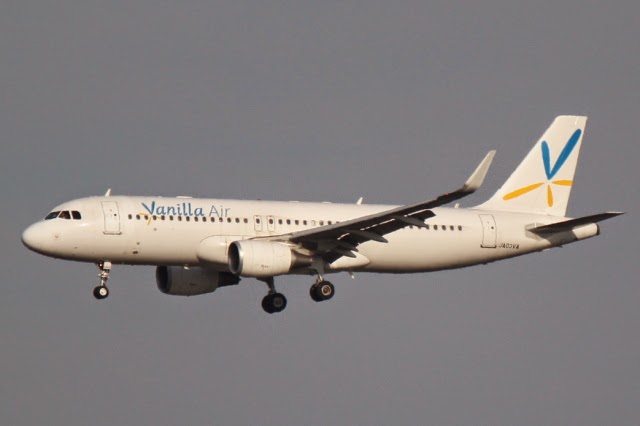
Airbus A320-216(SL) JA03VA comes in to land at Narita, Vanilla Air's hub. JA02VA and JA03VA fly in an incomplete white livery since they had been earmarked for AirAsia Japan (Mk I) but quick ownership change and re-launch under a new brand didn't allow time for a full paint job before service entry. (Photo: Ryosuke Yano)

Inaugural flight JW121 departed Narita at 1145 JST and arrived at Kaohsiung at 1518 NST. It was operated by A320-216(SL) JA05VA carrying 127 passengers (including three infants), four flight attendants, and two pilots. Load factor was 70.6%. Meanwhile, the inaugural return leg JW122 had 177 passengers booked, which equates to 98.3%.

Flight Schedule:
Narita – Kaohsiung NEW 1 daily with A320-200.
JW121 NRT 1145 – 1520 KHH 32A Daily *Feb/1 - Mar/28.
JW121 NRT 1025 – 1335 KHH 32A Daily *Mar/29 - Jun/30. Dep/arr 15 min early on Wed.
JW121 NRT 1025 – 1320 KHH 32A Daily *Jul/1 - Sep/30.
JW121 NRT 1010 – 1335 KHH 32A Daily *Oct/1 - 24. Dep 10 min early, arr 15 min early on Wed.
JW122 KHH 1600 – 2025 NRT 32A Daily *Feb/1 - Mar/28.
JW122 KHH 1415 – 1850 NRT 32A Daily *Mar/29 - Jun/30. Dep/arr 15 min early on Wed.
JW122 KHH 1400 – 1845 NRT 32A Daily *Jul/1 - Sep/30.

JW122 KHH 1415 – 1845 NRT 32A Daily *Oct/1 - 24. Dep/arr 15 min early on Wed.

The southern city of Kaohsiung becomes Vanilla Air's second destination in Taiwan after Taipei/Taoyuan [TPE/RCTP], which it serves three times daily. Having served the capital ever since re-launch under the current brand from AirAsia Japan (Mk I) [JW/WAJ] (Vanilla Air launches operations.), it sees Taiwan as a key market, which accounted for 21.1% of all visitors to Japan in 2014, becoming the largest inbound market by passenger number. South Korea came second with 20.5% followed by China with 18.0%, not including Hong Kong, which accounted for 6.9%.

The growing Japan – Taiwan market is increasingly becoming another LCC (as well as full-service carriers) battleground, with Peach Aviation [MM/APJ] planning to add a midnight Tokyo/Haneda [HND/RJTT] – Taipei/Taoyuan flight this summer (Peach plans Narita hub and Haneda – Taipei.), in addition to its flights to the Taiwanese capital from Osaka/Kansai [KIX/RJBB] and Okinawa/Naha [OKA/ROAH] along with Kansai – Kaohsiung (Peach launches Kaohsiung.). Scoot [TZ/SCO] already serves Narita – Taipei, and this year Tigerair Taiwan [IT/TTW] and V Air [ZV/VAX] are posed to enter.

Meanwhile, Vanilla Air will increase its Hong Kong service to double-daily from February 21st when their eighth A320 arrives, and on the other hand axe Seoul/Incheon [ICN/RKSI] from March 29th (Vanilla Air to suspend Seoul.). ANA Holdings, parent of All Nippon Airways [NH/ANA], recently announced that its wholly-owned Narita-based LCC subsidiary will keep its fleet at eight through FY2015. Deliveries of two A320s will be deferred to FY2016, while Vanilla Air "improves yield and revenue management."

Source: ANA Holdings, January 21st. (in Japanese)
Source: Aviation Wire, February 1st. (in Japanese)

Sunday, February 1, 2015

Skymark Airbus A330 operates last revenue flight.

On January 31st, Skymark Airlines [BC/SKY] ended Airbus A330 operations, only three days after filing for bankruptcy protection (Skymark to file for bankruptcy.) and announcing its decision to revert to an all-Boeing 737 fleet (Skymark to cut 15% of flights, ground all Airbus A330s.). The last flight out of Tokyo/Haneda [HND/RJTT] was BC727, service to Sapporo/New Chitose [CTS/RJCC] operated by Airbus A330-343E JA330D, which departed at 1904 JST and landed at 2037. The final flight became that aircraft's return leg BC730, which departed Hokkaido at 2121, and arrived back in Haneda at 2236.

Airbus A330-343E JA330A taxies after arriving into Haneda. Six have been delivered, of which one was only awaiting its ferry flight to Japan. Four remaining on order are now unlikely to be delivered. (Photo: Ryosuke Yano)

Japan's third largest carrier only took delivery of their first two A330s less than a year ago on February 28th, 2014 (Skymark Airlines' first two Airbus A330s delivered.). Powered by two Rolls-Royce Trent 772B-60 engines, the Airbus wide-bodied twin-jets boasted a generous seven-abreast (2-3-2) 271-seat layout, offering Green Seats with a 96.5-centimeter (38 inches) pitch, a 17.8-centimeter (7 inches) increase over seats on their 177-seat 737s.

Then President and CEO Shinichi Nishikubo had actively participated in the seat design, which was aimed at "offering better seats at an affordable price." Created by U.S.-based Zodiac Aerospace, the seats also had power sockets in every seat to lure business travelers. A controversial mini-skirt campaign uniform (Miniskirt turbulence at Skymark Airlines?) was introduced for flight attendants on the A330 to promote the brand-new equipment.

However, being the first A330 operator in Japan, Skymark's inexperience in having new aircraft certified as well as training crews (Skymark starts Airbus A330 training flights.) delayed service entry four times and pushed inauguration back by almost three months (Skymark delays Airbus A330 launch again; now June 14th.). It finally inaugurated service on June 14th on the highly-contested Haneda – Fukuoka [FUK/RJFF] route (Skymark Airlines inaugurates Airbus A330 service.).

Airbus A330-343E JA330D takes off from Haneda as BC727 on Skymark's last A330 flight out of Tokyo, with Tokyo SkyTree and skyscrapers in the background. (Photo: Aviation Wire)

Operations were expanded to New Chitose from August 1st (Skymark moves up Sapporo Airbus A330 ops to August 1st.) and Okinawa/Naha [OKA/ROAH] was planned from March 29th (Skymark takes ANA & JAL dual tie-up, axes Sendai – Sapporo.). Its product was enhanced further when free Wi-Fi was introduced aboard A330s on August 7th (Skymark to offer free Wi-Fi on Airbus A330.). Skymark became the first and to date only airline to have offered free Wi-Fi on domestic routes in Japan.

However, as it dumped capacity on trunk routes, Skymark often had to slash price of the A330s' premium seats to below that of rivals' economy fares; the more they flew the A330, the more they hemorrhaged. During the press conference when Skymark announced its filing for bankruptcy protection, Representative Chairman Takashi Ide said "Our first step is to eliminate things that are too costly; we won't fly A330s anymore. If we can negotiate a much lower leasing fee and can come up with a surely profitable strategy, we may consider it again." Pilots certified for the A330 will be retrained for the 737.

Mr. Ide added that talks are already underway with lessors Intrepid Aviation and CIT Aerospace and some third parties to sub-lease the aircraft out. Cancelling the lease outright would lead to penalties and Skymark would want to avoid that, however, their A330s' low-density premium layout without any in-flight entertainment may make it hard to find a new operator, unless a reconfiguration, which would also be costly, is implemented.

Source: Traicy, January 30th. (in Japanese)
Source: Aviation Wire, January 31st. (in Japanese)